Looking information, which debuts are the famous Göttingen manuscript, is known that these of debuts were 12. I know you were certainly following debuts - party Italian, defense Spanish . Please, serious entries, people who may have serious information. Please also do not rely 100 percent on the internet, as the information may be erroneous.
Sincerely
Krzysztof.
Göttingen manuscript
Moderator: Ras
-
Ajedrecista
- Posts: 2229
- Joined: Wed Jul 13, 2011 9:04 pm
- Location: Madrid, Spain.
Re: Göttingen manuscript.
Hello Krzysztof:
The Spanish National Library Biblioteca Nacional de España (BNE) offers a free download to that Lucena's book (30.7 MB of PDF). Link here:
http://bvpb.mcu.es/es/catalogo_imagenes ... n%3Dpagina
This book is written in Old Castillian. Since I am a native Spanish speaker, I am able to understand some parts of the text. Rules of chess start at page 80/258 of that PDF (the first rule literally starts: La primera regla es adoctrinar a los que no saben nada en este juego (The first rule is is to indoctrinate who know nothing in this game)), and the first listed opening is at page 83/258 (in the same page than the first diagramme). The notation is very verbose but in fact I can recognize the Damiano Defence. The second and third openings are the Philidor Defence and the Italian Game, the same than Wikipedia article for Göttingen Manuscript says. I have not checked the rest because the verbosity of the notation does not encourage to read fast.
I talked more about Lucena's book, but there is a high chance that both works share the same openings. I tried to find an online scan of the Göttingen Manuscript without success.
I hope you find this info useful.
Regards from Spain.
Ajedrecista.
I do not have serious information. Wikipedia lists twelve openings and I read from other sources that Lucena's book Repetición de amores y Arte de Ajedrez con 101 Juegos de Partido (dated from 1497) is very similar to Göttingen Manuscript, even having the same thirty problems in the same order.Krzysztof Grzelak wrote:Looking information, which debuts are the famous Göttingen manuscript, is known that these of debuts were 12. I know you were certainly following debuts - party Italian, defense Spanish . Please, serious entries, people who may have serious information. Please also do not rely 100 percent on the internet, as the information may be erroneous.
Sincerely
Krzysztof.
The Spanish National Library Biblioteca Nacional de España (BNE) offers a free download to that Lucena's book (30.7 MB of PDF). Link here:
http://bvpb.mcu.es/es/catalogo_imagenes ... n%3Dpagina
This book is written in Old Castillian. Since I am a native Spanish speaker, I am able to understand some parts of the text. Rules of chess start at page 80/258 of that PDF (the first rule literally starts: La primera regla es adoctrinar a los que no saben nada en este juego (The first rule is is to indoctrinate who know nothing in this game)), and the first listed opening is at page 83/258 (in the same page than the first diagramme). The notation is very verbose but in fact I can recognize the Damiano Defence. The second and third openings are the Philidor Defence and the Italian Game, the same than Wikipedia article for Göttingen Manuscript says. I have not checked the rest because the verbosity of the notation does not encourage to read fast.
I talked more about Lucena's book, but there is a high chance that both works share the same openings. I tried to find an online scan of the Göttingen Manuscript without success.
I hope you find this info useful.
Regards from Spain.
Ajedrecista.
-
Ajedrecista
- Posts: 2229
- Joined: Wed Jul 13, 2011 9:04 pm
- Location: Madrid, Spain.
More on Lucena's book.
Hello again:
Lucena's book is clearly written from white POV. Here is what I understood about openings in this book:
1. e4 e5 2. Nf3 f6 3. Nxe5 fxe5 4. Qh5+ g6 (A) 5. Qxe5+ (6. Qxh8)
4. (A) ... Ke7 5. Qxe5+ Kf7 6. Bc4+ d5 7. Bxd5+ Kg6 8. Qg3+ Qg5 9. Qxc7 Qxg2 10. Qf7+ Kh6 11. d4+ (or 11. d3+) g5 12. Qxf8+ Kh5 13. Qf7+ Kh4 14. e5 Qg4 etc. (I do not understand the next move).
There is one and a half more pages on this opening. What I wrote occupies more than half a page in the book!
1. e4 e5 2. Nf3 Nc6 3. Bc4 Bc5 4. d3 Nf6 5. h3 d6 6. Bb5 a6 7. Ba4 Bd7 8. Bxc6 (B) Bxc6
8. (B) Bb3
I am not sure on deeper lines, but it looks like there is b4 or b5 at some point, and Nc3, O-O; Be3, Bxe3; fxe3, h6; Qd2, Qe7; Rd1, Be6 (C); Bxe6 Qxe6 (I have doubts in these two plies).
(C) ... Rad8; g4, d5; exd5, (exchanges of bishops and knights); later Qg2 'and see how you get him more covered (I have my doubts) than him to you, and you must guide the game'.
1. e4 e5 2. Nf3 d6 3. c3 Nf6 4. h3 (4. ... Nxe4 5. Qa4+ and 6. Qxe4).
1. e4 e5 2. Nf3 Nf6 3. Nxe5 Nxe4 4. Qe2 Qe7 (D) 5. Qxe4 d6 6. d4 f5 (E) 7. Qe3 dxe5 (and white wins a pawn).
4. (D) ... Nf6 5. Nc6+ (and 6. NxQ).
6. (E) ... f6 7. f4 Nc6 8. Bb5 Bd7 9. Nc3 a6 (F) 10. Nd5
9. (F) ... Nxe5 10. Nd5 Nd3+ (G)(H) 11. cxd3 Qxe4+ 12. dxe4 Bxb5 13. Nxc7+
10. (G) ... Nf3+ 11. gxf3 Qxe4+ 12. fxe4
10. (H) ... Qd8 11. Bxd7+ Qxd7 12. dxe5 (or fxe5).
1. e4 d5 2. exd5 Qxd5 3. Nc3 Qe5+ (or Qe6+) 4. Be2 with white plan d4, Be3 and Bd3 (because the black queen retreated). White has the upper hand according to Lucena.
1. e4 *6 (a pawn to the sixth rank) 2. d4 (if possible, white must follow the plan c4, d4, e4, f4; y en aquella manera seréis señor del campo (and in that way you will be owner of the board)).
1. e4 e5 2. Bc4 d6 3. c3 Nc6 4. Nf3 Be6 5. Bxe6 fxe6 6. Qb3 (winning a pawn) Qc8 7. Ng5 Nd8 8. d4 (with the plan Be3, Nd2). Again, Lucena claims white has a better game.
But here are some lines if the reader plays with black pieces:
1. e4 e5 2. Nf3 Nc6 3. Bb5 Nge7 4. Bxc6 (I) Nxc6
4. (I) c3 d5 (equalyzes with Bd6 and Be6 according to Lucena).
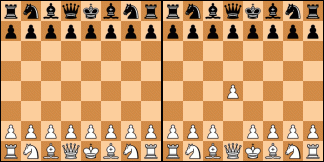
1. e3 e5 (king's pawn must never be advanced only one square in the opening, many French defence players will agree here... ) 2. d4 exd4 3. exd4 (J) d5
3. (J) Qxd4 d5 4. Qd1 Be6 5. Nc3 Nf6 6. Nf3 Bd6 7. Bd3 Nc6
And I lose myself in the doubt of what is written are various mainlines or the same mainline.
1. e4 e5 2. Bc4 c6 3. Qf3 Nf6 4. Qb3 d5 5. exd5 cxd5 6. Bb5+ Bd7 7. Bxd7+ Qxd7 (to defend b7 pawn) 8. d3 Nc6 9. Nf3 Bd6 10. Be3 Rc8 11. Rf1 (it looks like there were not castlings at that time and probably I have my doubts in the first opening) Na5 (and the white queen is trapped).
1. b3 d5 2. Bb2 c6 3. g3 b5 4. Bg2 e6 5. d4 f5 6. e3 g6 7. f4 Nf6 8. Nf3 Bg7 9. Rf1 (K) Bb7
9. (K) Rg1 a5 10. Nbd2 Nbd7 11. h4 Rf8 12. Ng5 Qe7 (and the plan is break on c5).
I hope no typos but it is very easy to confuse which moves go to which variants.
The openings included in Lucena's book are not the same as the listed openings of Göttingen Manuscript according to Wikipedia, but at least it gives an impression on the playing style and repertoire of the late XV century.
Regards from Spain.
Ajedrecista.
Lucena's book is clearly written from white POV. Here is what I understood about openings in this book:
1. e4 e5 2. Nf3 f6 3. Nxe5 fxe5 4. Qh5+ g6 (A) 5. Qxe5+ (6. Qxh8)
4. (A) ... Ke7 5. Qxe5+ Kf7 6. Bc4+ d5 7. Bxd5+ Kg6 8. Qg3+ Qg5 9. Qxc7 Qxg2 10. Qf7+ Kh6 11. d4+ (or 11. d3+) g5 12. Qxf8+ Kh5 13. Qf7+ Kh4 14. e5 Qg4 etc. (I do not understand the next move).
There is one and a half more pages on this opening. What I wrote occupies more than half a page in the book!
1. e4 e5 2. Nf3 Nc6 3. Bc4 Bc5 4. d3 Nf6 5. h3 d6 6. Bb5 a6 7. Ba4 Bd7 8. Bxc6 (B) Bxc6
8. (B) Bb3
I am not sure on deeper lines, but it looks like there is b4 or b5 at some point, and Nc3, O-O; Be3, Bxe3; fxe3, h6; Qd2, Qe7; Rd1, Be6 (C); Bxe6 Qxe6 (I have doubts in these two plies).
(C) ... Rad8; g4, d5; exd5, (exchanges of bishops and knights); later Qg2 'and see how you get him more covered (I have my doubts) than him to you, and you must guide the game'.
1. e4 e5 2. Nf3 d6 3. c3 Nf6 4. h3 (4. ... Nxe4 5. Qa4+ and 6. Qxe4).
1. e4 e5 2. Nf3 Nf6 3. Nxe5 Nxe4 4. Qe2 Qe7 (D) 5. Qxe4 d6 6. d4 f5 (E) 7. Qe3 dxe5 (and white wins a pawn).
4. (D) ... Nf6 5. Nc6+ (and 6. NxQ).
6. (E) ... f6 7. f4 Nc6 8. Bb5 Bd7 9. Nc3 a6 (F) 10. Nd5
9. (F) ... Nxe5 10. Nd5 Nd3+ (G)(H) 11. cxd3 Qxe4+ 12. dxe4 Bxb5 13. Nxc7+
10. (G) ... Nf3+ 11. gxf3 Qxe4+ 12. fxe4
10. (H) ... Qd8 11. Bxd7+ Qxd7 12. dxe5 (or fxe5).
1. e4 d5 2. exd5 Qxd5 3. Nc3 Qe5+ (or Qe6+) 4. Be2 with white plan d4, Be3 and Bd3 (because the black queen retreated). White has the upper hand according to Lucena.
1. e4 *6 (a pawn to the sixth rank) 2. d4 (if possible, white must follow the plan c4, d4, e4, f4; y en aquella manera seréis señor del campo (and in that way you will be owner of the board)).
1. e4 e5 2. Bc4 d6 3. c3 Nc6 4. Nf3 Be6 5. Bxe6 fxe6 6. Qb3 (winning a pawn) Qc8 7. Ng5 Nd8 8. d4 (with the plan Be3, Nd2). Again, Lucena claims white has a better game.
But here are some lines if the reader plays with black pieces:
1. e4 e5 2. Nf3 Nc6 3. Bb5 Nge7 4. Bxc6 (I) Nxc6
4. (I) c3 d5 (equalyzes with Bd6 and Be6 according to Lucena).
1. e3 e5 (king's pawn must never be advanced only one square in the opening, many French defence players will agree here...
) 2. d4 exd4 3. exd4 (J) d53. (J) Qxd4 d5 4. Qd1 Be6 5. Nc3 Nf6 6. Nf3 Bd6 7. Bd3 Nc6
And I lose myself in the doubt of what is written are various mainlines or the same mainline.
1. e4 e5 2. Bc4 c6 3. Qf3 Nf6 4. Qb3 d5 5. exd5 cxd5 6. Bb5+ Bd7 7. Bxd7+ Qxd7 (to defend b7 pawn) 8. d3 Nc6 9. Nf3 Bd6 10. Be3 Rc8 11. Rf1 (it looks like there were not castlings at that time and probably I have my doubts in the first opening) Na5 (and the white queen is trapped).
1. b3 d5 2. Bb2 c6 3. g3 b5 4. Bg2 e6 5. d4 f5 6. e3 g6 7. f4 Nf6 8. Nf3 Bg7 9. Rf1 (K) Bb7
9. (K) Rg1 a5 10. Nbd2 Nbd7 11. h4 Rf8 12. Ng5 Qe7 (and the plan is break on c5).
I hope no typos but it is very easy to confuse which moves go to which variants.
The openings included in Lucena's book are not the same as the listed openings of Göttingen Manuscript according to Wikipedia, but at least it gives an impression on the playing style and repertoire of the late XV century.
Regards from Spain.
Ajedrecista.
-
Krzysztof Grzelak
- Posts: 1612
- Joined: Tue Jul 15, 2014 12:47 pm
Re: Göttingen manuscript.
A huge and sincere thanks for the book and for the information.
-
Krzysztof Grzelak
- Posts: 1612
- Joined: Tue Jul 15, 2014 12:47 pm
Re: More on Lucena's book.
Probably you mentioned all tebiuty of this book. Certainly there were 10 but you can read it 11.