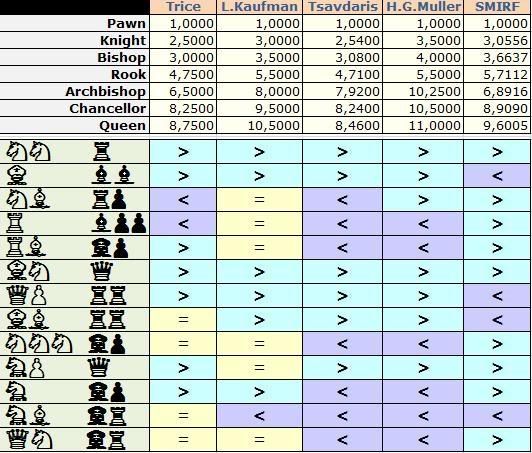
Fact is that A beats R+N+P more often than not, between equally strong opponents. So equating A to slightly over R+P, as your theory does, is basically equivalent to setting a Knight to zero. With as a consequence that Smirf often voluntarily gives piece odds to the opponent...
Another good example is this game from the 4th round:
Code: Select all
[Event "Computer Chess Game"]
[Site "SCHAAK_PC"]
[Date "2008.04.03"]
[Round "4.3"]
[White "Smirf 1.73f-X"]
[Black "BigLion 15mar"]
[Result "0-1"]
[TimeControl "3300+5"]
[Variant "capablanca"]
[FEN "rnbqckabnr/pppppppppp/10/10/10/10/PPPPPPPPPP/RNBQCKABNR w KQkq - 0 1"]
[SetUp "1"]
[Number "29"]

{--------------
r n b q c k a b n r
p p p p p p p p p p
. . . . . . . . . .
. . . . . . . . . .
. . . . . . . . . .
. . . . . . . . . .
P P P P P P P P P P
R N B Q C K A B N R
white to play
--------------}
1. Af3 Af6 2. Ag5 Ag4 3. Cf3 Cf6 4. Cg1 Cg8 5. Af3 Af6 6. Ae1 Ae8
{ Engines play from here: }
7. Nh3 {+0.32/11 2:07} d5 {+0.12/7 1:00} 8. g3 {+0.31/11 2:08}
Nj6 {+0.36/7 59} 9. Nc3 {+0.25/10 1:16} Ni4 {+0.34/6 7} 10.
Af3 {+0.68/12 2:28} d4 {+0.26/7 57} 11. Ni5 {+0.86/11 1:41}
Ch6 {+0.21/7 56} 12. h3 {+0.54/11 2:20} dxc3 {+0.80/7 55} 13.
d4 {+0.49/10 1:13} Cj6 {+0.80/7 54} 14. hxi4 {+0.66/10 57} cxb2 {+0.65/6 8}
15. Bxb2 {+0.34/11 1:04} h6 {+0.52/6 16} 16. Ah5 {+0.19/12 2:04}
Cxh5 {+2.04/7 29} 17. Nh7+ {+0.08/11 1:09} Kg8 18. ixh5 {+0.07/10 31}
Kxh7 {+2.15/7 38} 19. c3 {-0.10/10 1:56} f5 {+2.16/7 52} 20.
Bf3 {+0.06/11 1:10} Af7 {+2.16/6 11} 21. Ch3 {-0.02/11 1:50}
e5 {+2.29/7 50} 22. dxe5 {+0.24/11 1:47} Nd7 {+2.28/7 49} 23.
Bd5 {+0.41/9 1:21} Axe5 {+2.32/7 42} 24. O-O {-0.07/10 1:40}
Nb6 {+2.40/7 49} 25. Bf3 {-0.40/11 1:32} Qxd1 {+3.24/9 1:32} 26.
Rhxd1 {-0.50/12 1:01} Nc4 {+3.47/7 6} 27. Bc1 {-0.95/13 1:28}
Axc3 {+3.52/7 7} 28. Bf4 {-0.54/12 1:24} c6 {+3.66/7 28} 29.
Rac1 {-0.36/11 1:21} Axa2 {+4.34/8 1:36} 30. e4 {-1.04/11 1:19}
Nb6 {+4.25/7 39} 31. Rd8 {-1.11/10 1:11} Af7 {+4.34/6 31} 32.
Rf8 {-1.42/11 1:03} Ae6 {+4.42/7 8} 33. Bd6 {-1.98/11 51}
Bd7 {+4.26/8 1:31} 34. Rxa8 {-1.85/11 52} Nxa8 {+4.40/7 8} 35.
Rd1 {-2.02/10 24} Ag5 {+4.54/8 43} 36. Cxg5+ {-1.69/13 44} hxg5 {+4.38/8 4}
37. Bb8 {-1.73/12 18} Be6 {+4.09/10 1:20} 38. exf5 {-1.37/13 17}
Bxf5 {+3.65/9 24} 39. g4 {-1.14/13 15} Be6 {+3.64/8 8} 40.
Rd6 {-1.27/11 17} Bd5 {+3.44/8 24} 41. Bxd5 {-1.55/13 15} cxd5 {+3.16/8 0}
42. Bxa7 {-2.14/14 22} i6 {+3.27/9 10} 43. Rxd5 {-2.26/14 31}
Bi7 {+3.28/9 25} 44. Bd4 {-2.45/13 28} ixh5 {+3.35/9 33} 45.
gxh5 {-2.38/13 24} Rc8 {+3.34/8 24} 46. Kh2 {-2.39/12 9} Rc4 {+3.45/8 27}
47. Rd7 {-2.49/12 15} Bh6 {+3.51/9 45} 48. i3 {-3.24/12 21} b5 {+3.55/9 38}
49. Be5 {-2.85/12 18} g4 {+3.47/8 26} 50. Ki2 {-3.03/12 9}
Rc5 {+3.89/9 1:08} 51. Re7 {-3.37/13 20} b4 {+3.84/8 15} 52.
Bg3 {-3.44/12 12} Rxh5 {+4.56/7 0} 53. Rb7 {-3.78/11 3} Bd2 {+4.49/7 3} 54.
Rb8 {-3.86/11 9} Ra5 {+4.66/8 20} 55. Bd6 {-4.45/11 9} Ra2 {+4.54/9 1:04}
56. Kj3 {-4.09/12 5} Be1 {+4.60/9 1:00} 57. Rj8 {-4.53/13 16}
Ki7 {+4.56/9 58} 58. Bf4+ {-4.22/13 15} Ki6 {+4.70/9 55} 59.
Ri8+ {-4.37/14 15} Kh5 {+4.66/9 24} 60. Rg8 {-4.11/12 11} Bc3 {+4.83/8 28}
61. i4+ {-4.07/12 3} Kg6 {+5.06/9 51} 62. Bg3 {-4.66/11 3} b3 {+7.51/9 21}
63. Rb8 {-8.18/13 9} b2 {+7.88/8 0} 64. Rb3 {-8.22/12 8} Ra6 {+8.51/9 32}
65. Rxc3 {-8.42/11 7} b1=Q {+9.03/8 17} 66. Rc4 {-8.63/11 7}
Qh1+ {+9.03/7 28} 67. Kj4 {-8.89/12 11} Qj1 {+9.04/7 25} 68.
Bh4 {-9.51/11 5} Qg1+ {+9.20/7 26} 69. Bi3 {-11.09/14 10} Qg2 {+9.48/8 23}
70. Rc5 {-11.03/11 4} Qxf2 {+10.52/8 16} 71. Rb5 {-12.09/12 9}
g3 {+10.81/7 18} 72. Bh4 {-12.27/11 5} Qh2+ {+11.59/7 13} 73.
Bi3 {-14.56/14 8} Qh6+ {+12.68/8 39} 74. Kj3 {-15.48/13 8}
Qh1+ {+12.83/8 38} 75. Kj4 {-15.36/3 0} g2 {+12.87/8 36} 76.
Rh5 {-15.76/12 8} g1=Q {+12.88/7 19} 77. Bxg1 {-27.69/13 0}
Qxg1+ {+13.38/6} 78. Kj5 {-24.20/9 0} Ra3 {+15.03/8 33} 79. j4 {-55.50/8 0}
Rj3 {+20.34/6 2} 80. Rh6+ gxh6 {+309.87/1} 81. Kj6 {-24.43/2 0}
Qxj4+ {+309.89/1} 82. Ki7 Qj6+ {+309.91/1} 83. Ki8 {-21.65/2 0}
Qi6+ {+309.93/1} 84. Kj8 Qg8+ {+309.95/1} 85. Ki7 Qh7+ {+309.97/1} 86.
Kj8 {-22.37/2 0} Qh8# {+309.99/1}
{Xboard adjudication: Checkmate} 0-1
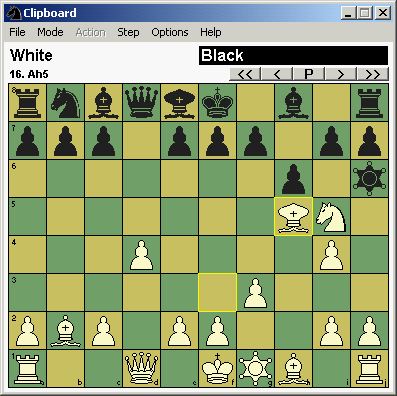
With 16. Ah5? Smirf traps the black Chancellor such that black is forced to trade it for the Archbishop. But since Smirf does this when its Knight is attacked by a Pawn, he loses the Knight in the process, for no other compensation that a bit of reduced black King safety (6. ..., CxA 7. Nh7+, Kg8 8. PxC, KxN). A Knight that could have been simply withdrawn. After that, even outseraching the opponent by 4-5 ply cannot avert the loss.
Which "other weaknesses" do cause such disastrous trades as A vs B+N against Fairy-Max and A+N vs C against BigLion, according to you, if it is not equating A to R+P+1/4?
Let me put it another way: If you let Smirf play 100 games against itself from the position
rnbqck1bnr/pppppppppp/10/10/10/10/PPPP1P1PPP/1NBQCKABNR w Kkq 0 1
(i.e. white has Archbishop, against a Rook plus two Pawns), what would be white's score, roughly? I am sure that with the current piece values Smirf would blunder away its A for two minors or R+P on many occasions, but in most cases it will not get an opportunity to do that. (As it is self-play, the opponent will stupidly avoid such trades!) I predict you that white will score 75% or better! Have you ever tried this?