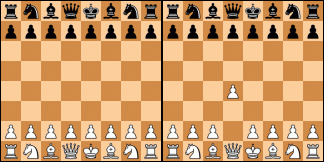
With 4 ranks it is obviously mate in 1 for white who win by e2xf3#
What about 5 ranks or 6 rankss?
Is there a software to analyze it?
rules are the same as normal chess when pawns can go 2 squares forward only in the first move and promote when they go to their last rank.
I guess white is going to win with 5 ranks but I know no software to make a serious analysis.
Not sure about 6 ranks or 7 ranks
I wonder if chess is a draw with less ranks
Moderator: Ras
-
Uri Blass
- Posts: 11147
- Joined: Thu Mar 09, 2006 12:37 am
- Location: Tel-Aviv Israel
-
jefk
- Posts: 1084
- Joined: Sun Jul 25, 2010 10:07 pm
- Location: the Netherlands
- Full name: Jef Kaan
Re: I wonder if chess is a draw with less ranks
you could setup some prototype(s) - in a rather easy- way with
Zillionsofgames and then see how it goes; disadvantage then is that
the engine isn't strong. So that would result in yet some more chess
variants; thereby with much less ranks i would be inclined to let the
first pawns moves only going one rank further (instead of two).
Zillionsofgames and then see how it goes; disadvantage then is that
the engine isn't strong. So that would result in yet some more chess
variants; thereby with much less ranks i would be inclined to let the
first pawns moves only going one rank further (instead of two).
-
Jouni
- Posts: 3784
- Joined: Wed Mar 08, 2006 8:15 pm
- Full name: Jouni Uski
Re: I wonder if chess is a draw with less ranks
I guess, that 5, 6 and possible 7 ranks can be fully analyzed in reasonable time.
Jouni
-
Uri Blass
- Posts: 11147
- Joined: Thu Mar 09, 2006 12:37 am
- Location: Tel-Aviv Israel
Re: I wonder if chess is a draw with less ranks
I agree about 5 but I am not sure if it is possible to analyze 6 ranks in a reasonable time.
Even without solving the game we probably can get conclusions about 6 and 7 based on engine-engines games like we do in chess because all engine-engine games end at the same result but it is not a proof.
We can have 2 options for the pawn moves.
Generalization of chess can claim that the pawn is allowed to move 2 squares forward in the first move but another generalization is when the pawn is allowed to move 2 pawns forward only when it is at distance of at least 6 ranks from promotion and in this case smaller board means not being able to move 2 squares forward.
Both are natural generalization of chess.
I guess it is simpler to solve the problem when the pawn is not allowed to move 2 squares forward because we have less possibilities.
-
Ajedrecista
- Posts: 2175
- Joined: Wed Jul 13, 2011 9:04 pm
- Location: Madrid, Spain.
Re: I wonder if chess is a draw with less ranks.
Hello Uri:
Wikipedia features an article on minichess. The 6×6 bishopless variant (RNQKNR) is historically significant in computer chess in the 1950s: Los Alamos chess variant as the first chess-like game played by a computer programme (no pawn double-step move, no en passant captures, no castlings and no underpromotions to bishops). The original report with technical details of MANIAC I playing Los Alamos Chess is found at pages 13 to 16 of the January, 1957 issue of Chess Review magazine (link to the issue).
------------
I have been interested for years in the same concept of miniboards of English draughts/American checkers until I found a software a week ago to play with (link to the post)! It is the historic SAGE programme. I stick to even numbers of files and ranks to keep symmetries of the two sides. My finds with best play so far are:
The second player win in 4×6 should be something like this:
Odd numbers for files and/or ranks can be tried, of course, as well as different pieces per side than the usual (Files/2)*(Ranks - 2)/2 = (Files/2)*(Ranks/2 - 1).
------------
Hello Jouni:
Regards from Spain.
Ajedrecista.
Excellent question, as usual. I do not know about such software. I would add that telling the board size is not enough. For example, in 4×4, are we talking about RQKR setting or NQKN or BQKB or other one? The same with the first move of pawns, castlings and en passant captures in enough large boards.Uri Blass wrote: ↑Sun Dec 28, 2025 8:47 am With 4 ranks it is obviously mate in 1 for white who win by e2xf3#
What about 5 ranks or 6 rankss?
Is there a software to analyze it?
rules are the same as normal chess when pawns can go 2 squares forward only in the first move and promote when they go to their last rank.
I guess white is going to win with 5 ranks but I know no software to make a serious analysis.
Not sure about 6 ranks or 7 ranks
Wikipedia features an article on minichess. The 6×6 bishopless variant (RNQKNR) is historically significant in computer chess in the 1950s: Los Alamos chess variant as the first chess-like game played by a computer programme (no pawn double-step move, no en passant captures, no castlings and no underpromotions to bishops). The original report with technical details of MANIAC I playing Los Alamos Chess is found at pages 13 to 16 of the January, 1957 issue of Chess Review magazine (link to the issue).
------------
I have been interested for years in the same concept of miniboards of English draughts/American checkers until I found a software a week ago to play with (link to the post)! It is the historic SAGE programme. I stick to even numbers of files and ranks to keep symmetries of the two sides. My finds with best play so far are:
Code: Select all
Pieces per side = (Files/2)*(Ranks/2 - 1)

=======================================
   SIZE        Pieces
Files Ranks   per side   Result
=======================================
  4     4        2       Draw
  4     6        4       2nd player win
  4     8        6       Draw
  6     4        3       Draw
  6     6        6       Draw
  6     8        9       Draw
  8     4        4       Draw
8 6 8 DrawCode: Select all
1st player pieces on 1, 2, 3 and 4.
2nd player pieces on 9, 10, 11 and 12.

   2nd PLAYER
+---+---+---+---+
|   | 12|   | 11|
+---+---+---+---+
| 10|   | 9 |   |
+---+---+---+---+
|   | 8 |   | 7 |
+---+---+---+---+
| 6 |   | 5 |   |
+---+---+---+---+
|   | 4 |   | 3 |
+---+---+---+---+
| 2 |   | 1 |   |
+---+---+---+---+
   1st PLAYER

 1.  4-6   10-8     2.  2-4   12-10     3.  3-5     8x3     4.  4-5    9-7     5.  5-8   10x5
 6.  6-8    5-4     7.  1x6    3-1      8.  8-10    1-3     9. 10-12   3-5    10. 12-10   5-8
11. 10x5    7x4    12.  6-8    4-1     13.  8-10   11-9    14. 10-12   9-8    15. 12-9    1-3
16.  9x6    3-5    17.  6-8    5x10

 1.  4-6   10-8     2.  2-4   12-10     3.  3-5     8x3     4.  4-5    9-7     5.  5-8   10x5
 6.  6-8    5-4     7.  1x6    7-5      8.  8-10    3-1     9. 10-12   5-4    10. 12-10   1-3
11. 10-8    4-1    12.  8-10   3-5     13. 10-12    5-8    14.  6x9   11x8    12. 12-9    1-3
16. 9x6 3-5 17. 6-8 5x10------------
Hello Jouni:
I disagree on 7×7 full analysis in reasonable time due to the high branching factor and the state-space complexity. I even doubt about 6×6 for the same reasons, but I would be happy if proven wrong.
Regards from Spain.
Ajedrecista.
-
Uri Blass
- Posts: 11147
- Joined: Thu Mar 09, 2006 12:37 am
- Location: Tel-Aviv Israel
Re: I wonder if chess is a draw with less ranks.
Note that I thought about 8 files because with less files it is not clear what is the initial position so the board is 5*8 6*8 or 7*8Ajedrecista wrote: ↑Sat Jan 10, 2026 7:50 pm Hello Uri:
Excellent question, as usual. I do not know about such software. I would add that telling the board size is not enough. For example, in 4×4, are we talking about RQKR setting or NQKN or BQKB or other one? The same with the first move of pawns, castlings and en passant captures in enough large boards.Uri Blass wrote: ↑Sun Dec 28, 2025 8:47 am With 4 ranks it is obviously mate in 1 for white who win by e2xf3#
What about 5 ranks or 6 rankss?
Is there a software to analyze it?
rules are the same as normal chess when pawns can go 2 squares forward only in the first move and promote when they go to their last rank.
I guess white is going to win with 5 ranks but I know no software to make a serious analysis.
Not sure about 6 ranks or 7 ranks
Wikipedia features an article on minichess. The 6×6 bishopless variant (RNQKNR) is historically significant in computer chess in the 1950s: Los Alamos chess variant as the first chess-like game played by a computer programme (no pawn double-step move, no en passant captures, no castlings and no underpromotions to bishops). The original report with technical details of MANIAC I playing Los Alamos Chess is found at pages 13 to 16 of the January, 1957 issue of Chess Review magazine (link to the issue).
------------
I have been interested for years in the same concept of miniboards of English draughts/American checkers until I found a software a week ago to play with (link to the post)! It is the historic SAGE programme. I stick to even numbers of files and ranks to keep symmetries of the two sides. My finds with best play so far are:
The second player win in 4×6 should be something like this:Code: Select all
Pieces per side = (Files/2)*(Ranks/2 - 1)

=======================================
   SIZE        Pieces
Files Ranks   per side   Result
=======================================
  4     4        2       Draw
  4     6        4       2nd player win
  4     8        6       Draw
  6     4        3       Draw
  6     6        6       Draw
  6     8        9       Draw
  8     4        4       Draw
  8     6        8       Draw
Odd numbers for files and/or ranks can be tried, of course, as well as different pieces per side than the usual (Files/2)*(Ranks - 2)/2 = (Files/2)*(Ranks/2 - 1).Code: Select all
1st player pieces on 1, 2, 3 and 4.
2nd player pieces on 9, 10, 11 and 12.

   2nd PLAYER
+---+---+---+---+
|   | 12|   | 11|
+---+---+---+---+
| 10|   | 9 |   |
+---+---+---+---+
|   | 8 |   | 7 |
+---+---+---+---+
| 6 |   | 5 |   |
+---+---+---+---+
|   | 4 |   | 3 |
+---+---+---+---+
| 2 |   | 1 |   |
+---+---+---+---+
   1st PLAYER

 1.  4-6   10-8     2.  2-4   12-10     3.  3-5     8x3     4.  4-5    9-7     5.  5-8   10x5
 6.  6-8    5-4     7.  1x6    3-1      8.  8-10    1-3     9. 10-12   3-5    10. 12-10   5-8
11. 10x5    7x4    12.  6-8    4-1     13.  8-10   11-9    14. 10-12   9-8    15. 12-9    1-3
16.  9x6    3-5    17.  6-8    5x10

 1.  4-6   10-8     2.  2-4   12-10     3.  3-5     8x3     4.  4-5    9-7     5.  5-8   10x5
 6.  6-8    5-4     7.  1x6    7-5      8.  8-10    3-1     9. 10-12   5-4    10. 12-10   1-3
11. 10-8    4-1    12.  8-10   3-5     13. 10-12    5-8    14.  6x9   11x8    12. 12-9    1-3
16.  9x6    3-5    17.  6-8    5x10
------------
Hello Jouni:
I disagree on 7×7 full analysis in reasonable time due to the high branching factor and the state-space complexity. I even doubt about 6×6 for the same reasons, but I would be happy if proven wrong.
Regards from Spain.
Ajedrecista.
Note sure if 5*8 is easier than 6*6 5*8=40>6*6=36 but pawns are closer to promotion in 5*8 game so it may be easier.
-
Ajedrecista
- Posts: 2175
- Joined: Wed Jul 13, 2011 9:04 pm
- Location: Madrid, Spain.
Re: I wonder if chess is a draw with less ranks.
Hello Uri:
1.- e3, d5; 2.- Qxg4, f3; 3.- Qf4# (1-0)
1.- g3, c3; 2.- dxc3, dxc3; 3.- Bxf4# (1-0)
1.- g3, c3; 2.- dxc3, dxc3; 3.- gxf4# (1-0)
1.- g3, c3; 2.- dxc3, Nxc3; 3.- Bxf4# (1-0)
1.- g3, c3; 2.- dxc3, Nxc3; 3.- gxf4# (1-0)
And many more exploiting the same ideas, just shuffling other pieces in the losing side. Here is an opening trap:
1.- c3, dxc3; 2.- dxc3??, Bxf2+; 3.- Kxf2, Qxd1 (0-1)
Any shorter checkmate/s and/or opening traps in 5×8 are welcome!
Regards from Spain.
Ajedrecista.
Very true. I fully understand now that you wonder about normal RNBQKBNR settings on n×8 boards, with 3 < n < 8 (n = {4, 5, 6, 7}). I tried to find the shortest possible checkmate/s in 5×8, like fool's mate in standard chess. I got some on my own, with the losing side collaborating:
1.- e3, d5; 2.- Qxg4, f3; 3.- Qf4# (1-0)
1.- g3, c3; 2.- dxc3, dxc3; 3.- Bxf4# (1-0)
1.- g3, c3; 2.- dxc3, dxc3; 3.- gxf4# (1-0)
1.- g3, c3; 2.- dxc3, Nxc3; 3.- Bxf4# (1-0)
1.- g3, c3; 2.- dxc3, Nxc3; 3.- gxf4# (1-0)
And many more exploiting the same ideas, just shuffling other pieces in the losing side. Here is an opening trap:
1.- c3, dxc3; 2.- dxc3??, Bxf2+; 3.- Kxf2, Qxd1 (0-1)
Any shorter checkmate/s and/or opening traps in 5×8 are welcome!
Regards from Spain.
Ajedrecista.
-
lkaufman
- Posts: 6280
- Joined: Sun Jan 10, 2010 6:15 am
- Location: Maryland USA
- Full name: Larry Kaufman
Re: I wonder if chess is a draw with less ranks
A different but related question that I find interesting and potentially important, is this: What is the smallest rule change from standard chess that would put the result near the win-draw line, so that with Armageddon rule it would be fully playable for the best engines? We determined some years ago that "Black cannot castle short" is near that line; also "White plays first with 1.e4 on the board" is fairly near the line, though probably on the draw side. "Black must avoid repetition" might also be near the line, though that is harder to test and I know of no data. Many other options are possible, not all are easy to evaluate.
Komodo rules!
-
Uri Blass
- Posts: 11147
- Joined: Thu Mar 09, 2006 12:37 am
- Location: Tel-Aviv Israel
Re: I wonder if chess is a draw with less ranks
part of the options that you give are simply changing the initial position and not changing the rules so engines can play it.lkaufman wrote: ↑Wed Jan 14, 2026 9:30 pm A different but related question that I find interesting and potentially important, is this: What is the smallest rule change from standard chess that would put the result near the win-draw line, so that with Armageddon rule it would be fully playable for the best engines? We determined some years ago that "Black cannot castle short" is near that line; also "White plays first with 1.e4 on the board" is fairly near the line, though probably on the draw side. "Black must avoid repetition" might also be near the line, though that is harder to test and I know of no data. Many other options are possible, not all are easy to evaluate.
If we talk about changing the rules.
For black must avoid repetition we need to change chess engines to know repetition is a loss for black and I guess that black can draw by stalemate or by fifty move rule.
Other options of changing the target of the game without changing the intial position may be that white is winning by mate or by something else.
Examples:mate or promote a pawn.
If it is still a draw maybe mate or push a pawn to the 7th and if it is still a draw maybe mate or push a pawn to the 6th.
Mate or capturing the oppoent queen and rooks so black need to draw but also not to allow trades of too many pieces.
White win by mate or push a specific piece to specific square( a lot of options and I do not know what will be 50%)
I think that we need engines tthat allow us to change the target of the game to test it.
-
Ajedrecista
- Posts: 2175
- Joined: Wed Jul 13, 2011 9:04 pm
- Location: Madrid, Spain.
Re: I wonder if chess is a draw with less ranks.
Hello Uri:
I discovered more checkmates in three moves (five plies for 1-0 and six plies for 0-1), for example:
1.- d3, a3; 2.- Qd2, axb2; 3.- Qxf4# (1-0).
1.- e3, a3; 2.- g3, axb2; 3.- exf4# (1-0).
1.- e3, Nh3; 2.- Ne2, Ng5; 3.- exf4# (1-0).
1.- e3, Nh3; 2.- Ne2, Ng5; 3.- g3, Nf3# (0-1).
These ideas can be reached through many ways with the losing side collaborating.
I also want to note an opening blunder: 1.- e3, g3??; 2.- Qxh5 (1-0).
------------
Regarding the OP of this thread:
ROOT SITE:
Mini Chess Resolution
5×5: Gardner Chess and Mallet Chess:
Gardnerfish : a Gardner chess engine based on Stockfish
GUI for 5x5 chess
Oracle for Gardner minichess variant
Proof that Mallett Chess is a forced win for White
6×6 Los Alamos Chess:
Los Alamos Chess Engine
I know that it is not what you asked for, but someone might find it useful.
Regards from Spain.
Ajedrecista.
Following with 5×8, I want to correct a typo in the first checkmate of my former post: it should be 1.- e3, d3; ... instead of 1.- e3, d5; ...Ajedrecista wrote: ↑Wed Jan 14, 2026 9:13 pm Hello Uri:
Very true. I fully understand now that you wonder about normal RNBQKBNR settings on n×8 boards, with 3 < n < 8 (n = {4, 5, 6, 7}). I tried to find the shortest possible checkmate/s in 5×8, like fool's mate in standard chess. I got some on my own, with the losing side collaborating:
1.- e3, d5; 2.- Qxg4, f3; 3.- Qf4# (1-0)
1.- g3, c3; 2.- dxc3, dxc3; 3.- Bxf4# (1-0)
1.- g3, c3; 2.- dxc3, dxc3; 3.- gxf4# (1-0)
1.- g3, c3; 2.- dxc3, Nxc3; 3.- Bxf4# (1-0)
1.- g3, c3; 2.- dxc3, Nxc3; 3.- gxf4# (1-0)
And many more exploiting the same ideas, just shuffling other pieces in the losing side. Here is an opening trap:
1.- c3, dxc3; 2.- dxc3??, Bxf2+; 3.- Kxf2, Qxd1 (0-1)
Any shorter checkmate/s and/or opening traps in 5×8 are welcome!
Regards from Spain.
Ajedrecista.
I discovered more checkmates in three moves (five plies for 1-0 and six plies for 0-1), for example:
1.- d3, a3; 2.- Qd2, axb2; 3.- Qxf4# (1-0).
1.- e3, a3; 2.- g3, axb2; 3.- exf4# (1-0).
1.- e3, Nh3; 2.- Ne2, Ng5; 3.- exf4# (1-0).
1.- e3, Nh3; 2.- Ne2, Ng5; 3.- g3, Nf3# (0-1).
These ideas can be reached through many ways with the losing side collaborating.
I also want to note an opening blunder: 1.- e3, g3??; 2.- Qxh5 (1-0).
------------
Regarding the OP of this thread:
exf3# noted by you is a 1-move checkmate in 4×8, but also gxf3#.
I found a site that claims modified versions of SF to play minichess, mainly some 5×5 variants and 6×6 Los Alamos:Uri Blass wrote: ↑Sun Dec 28, 2025 8:47 am[...]
Is there a software to analyze it?
rules are the same as normal chess when pawns can go 2 squares forward only in the first move and promote when they go to their last rank.
I guess white is going to win with 5 ranks but I know no software to make a serious analysis.
Not sure about 6 ranks or 7 ranks
ROOT SITE:
Mini Chess Resolution
5×5: Gardner Chess and Mallet Chess:
Gardnerfish : a Gardner chess engine based on Stockfish
GUI for 5x5 chess
Oracle for Gardner minichess variant
Proof that Mallett Chess is a forced win for White
6×6 Los Alamos Chess:
Los Alamos Chess Engine
I know that it is not what you asked for, but someone might find it useful.
Regards from Spain.
Ajedrecista.