Testing Selective Search - Computer Chess Fun Olympiad 2010

Discussion of computer chess matches and engine tournaments.

Moderator: Ras

User avatar
Spacious_Mind
Posts: 317
Joined: Mon Nov 02, 2009 12:05 am
Location: Alabama

Testing Selective Search - Computer Chess Fun Olympiad 2010

Post by Spacious_Mind »

Hi everyone,

I normally spend a lot of time with dedicated chess computers and old home computers. Why? Because they amaze me on how much was done back in the old days with so little. So little memory. So little speed. So little technology compared to today.

Recently I finished a monster tournament between Commodore 64 software and comparable dedicated chess computers, which I found very enjoyable because I was permanently amazed by the little 1 MHz computer as the written software of the top programmers of the day churned out amazingly good moves while rarely moving beyond 3 ply in their search.

Well, this caused me to think nostalgically, wouldnt it be nice to just see how these old programs would play against the modern programs of today. My first thoughts on this were that they would likely get hammered.....but then I wondered why not try it out and see what would really happen.

Picking up my TASC Final Chesscard for the Commodore 64, I then decided to play a 5 ply game (figuring this is easy since the engine and the Chesscard can both be set to play at this level setting). Well the Chesscard took a few seconds for it's moves and the engine fractions of a second.... but interestingly both programs seemed to show search extensions (variation extensions) occasionally beyond 5 ply although they both conformed to the 5 ply search. Now this seemed interesting to me, because it seems that even in ply both searched selectively. I then played Brute Force with the Final Chesscard and at that point I could definately see that in Brute Force a 5 ply search would take many minutes to play.
Now this excited me, because the idea of playing old against new became a much more realistic possibility. Taking out my Atari 800, I then loaded Colossus 4 and set it to Infinite Level and played a few moves. It took the program over 30 minutes (1.79 MHz) to search through 5 Ply Brute Force. Now setting it to 30 seconds per move for a real game it would reach 4 ply but not go beyond that. At 40/2hrs it would reach 5 ply but rarely unless it is a simple endgame would it go beyond 5 ply. I then tried the same on my C64 and the results were the same (taking into consideration the speed difference between a C64 and Atari 800).

Therefore it seems to me that the way to play matches against these old programs and new programs is to let them do what is natural as much as possible. Ideally the best way would be if Winboard or some other platform had a way to control moves at fractions of a second, which unfortunately they do not. Another difficulty with this is knowing how much allowance to provide to an engine for it's start delay.

Since the above is currently not possible, the only way to try this out is to play ply games with modern engines, knowing that this might curb some of the techniques that modern engines use. But, I also have a feeling since they continue to search within Ply selectively that this is not much different to the old software techniques for playing games with level settings.

Therefore I decided to play a Test Tournament anyway under the following conditions which I feel would allow the programs to behave naturally.

The Tournament is a Team tournament and I am playing this for fun and for the experience of understanding and enjoying the respective chess programs. All the moves will be manually input (even between engines) because I feel this allows me to follow their games and enjoy them. The contestants for the Tournament were placed into 6 sections as follows:

Image

Section 1 comprises of Teams of Old Home Computers. Several of the software are the same (there just weren't too many choices back then), but I wanted to play them anyway because of wanting to see if the softwares remained the same while ported to the various platforms (Often the programmer was different ie.. Skeet Hannigan for Sargon III C64 and Alex Ford for Amiga) I also know from a programmer back then that sometimes for particular platforms they had to be creative because of lack of ROM and RAM. Therefore I am curious how they all play in this Tournament. The Final Chesscard I will use as a special test to see if there are differences between Agressive and Normal game style and also differences between 5 Ply selective search and Level game play selective search.

From my trial and errors with the C64, I have decided to allow all the old chess computers to play their Level settings. The starting base is 225 seconds per move for the C64 (= 40/2.1/2 hrs), or a level that is closest to this. An Atari 800 for example at 1.79 MHz playing Colossus 4 would get 2 Hrs 5 minutes and 42 seconds to play 60 moves (7542s/60). The nearest lower level for Sargon III is Level 5.

Image

Section 2 - Is a dedicated chess computer section. I have played around with these these and here also I find that the fairest setting for everyone would be to use corresponding appropriate level settings. Ply does not work either because for example in the case of Mephisto Vancouver 68020 5 ply would mean that it would still selectively search variations up to 12 deep, which I think would be a great disadvantage to Modern Engines. Therefore instead Mephisto Vancouver (12 MHz) would play 60/19m or in the case of Mephisto Magellan 10 seconds per move.

Image

Section 3 - Has a mixture of dedicated chess computers which will play with appropriate level settings or ply in TASC's case, and DOS/Windows software. The DOS/Windows software will play 5 ply. With DOS/Windows software I do not know if they all play selectively or brute force but we will finds out....

Image

Section 4 - Are mostly classic chess engines that I enjoyed playing over the years. It is a chess engine nostalgia section. All these engines will play 5 ply. For 5 PLY games I will use Arena whereever possible, but some engines will have to play in Chessbase/Fritz gui.
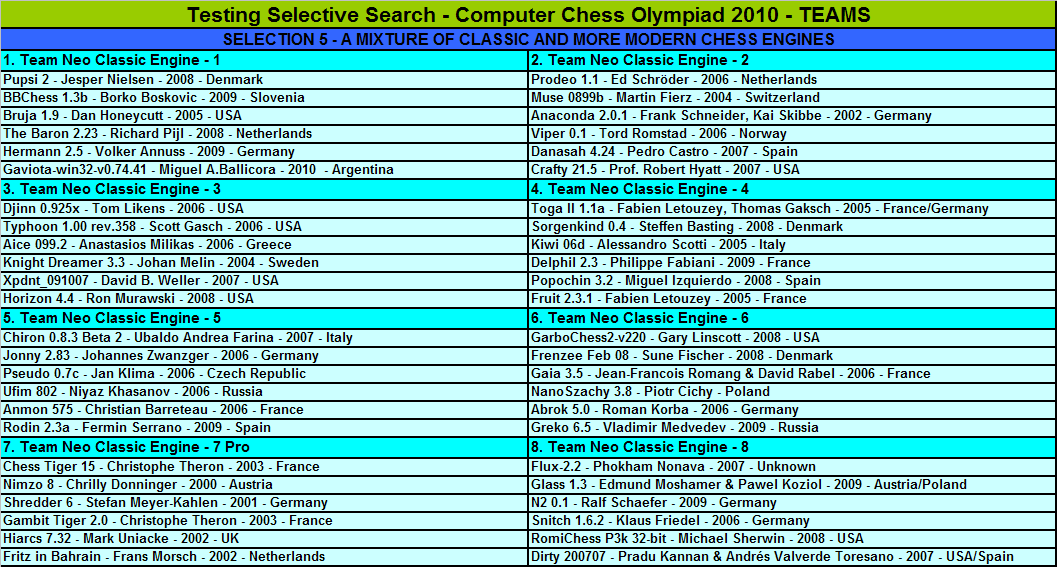
Image

Section 5 - Comprises of some old and some newer engines. Kind of in the middle between the Classic engines and the New Engines. Again all will play 5 Ply.

Image

Section 6 - Represented here are all the Modern TOP engines of the world. Some of the latest top PRO engines I don't have (been spending all my money in the last couple of years on dedicateds :) ) but I think there is a good representation in this section. I would have liked to have included some others like Junior but these fail the 5 ply test since the mimum ply is 6.

I used http://www.random.org/ to randomply pick the teams for the Tournament Groups (I also did the same for most of the engine groups). The Tournament Groups are as follows:

Image

Because I don't want to have too many computers and dedicated computers spread across the room, I will be playing each individual group from start to finish, before I move on to the next Group.

GROUP A has started and looks as follows:

Image

Round 1

Image

36 games were played in Round 1 and most of them were really hard contested. The Old Home Computers posted some surprisingly good results. Poor DOS/Windows, it seems that they will struggle in the Group.

Standings after 1 Round

Image

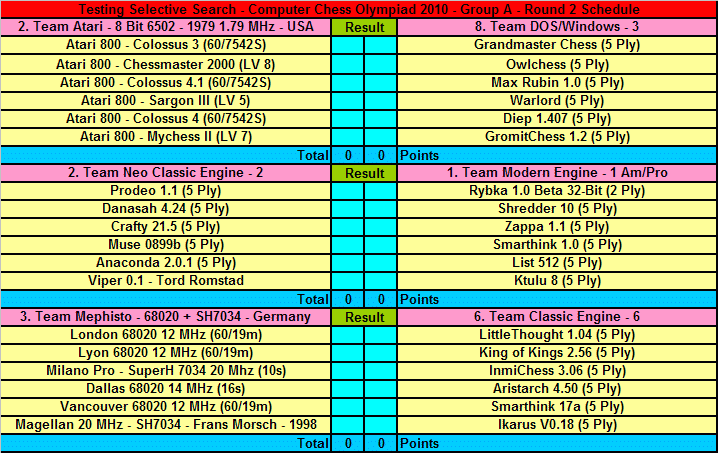
The Round 2 schedule is as follows:
Image

All the schdules are randomly picked using http://www.random.org/, even the coin toss to see who starts with white first :) .

If there is an interest in the actual games played in this Tournament, please let me know and I will post them here also.

I know this is a little different to most of the Tournaments played in this Forum, but I hope you will find it interesting. I am playing this for the sheer enjoyment and for very little science :)

Best regards

Nick
Steve B
Posts: 3697
Joined: Tue Jul 31, 2007 4:26 pm

Re: Testing Selective Search - Computer Chess Fun Olympiad 2

Post by Steve B »

Excellent Tournament Idea Nick

i will follow the progress very closely as the results will be very interesting

Best Regards
Steve
User avatar
Spacious_Mind
Posts: 317
Joined: Mon Nov 02, 2009 12:05 am
Location: Alabama

Re: Testing Selective Search - Computer Chess Fun Olympiad 2

Post by Spacious_Mind »

Steve B wrote:Excellent Tournament Idea Nick

i will follow the progress very closely as the results will be very interesting

Best Regards
Steve
Hi Steve,

Thanks for the vote of confidence :)

I will try and post more results as I play them. A lot of the games are really exciting.....

regards

Nick
User avatar
Spacious_Mind
Posts: 317
Joined: Mon Nov 02, 2009 12:05 am
Location: Alabama

Re: Testing Selective Search - Computer Chess Fun Olympiad 2

Post by Spacious_Mind »

Steve B wrote:Excellent Tournament Idea Nick

i will follow the progress very closely as the results will be very interesting

Best Regards
Steve
Hi Steve,

ps.... I forgot to mention, if you feel any of the settings for the dedicateds are wrong or unfair then please let me know :)

regards
Nick
User avatar
michiguel
Posts: 6401
Joined: Thu Mar 09, 2006 8:30 pm
Location: Chicago, Illinois, USA

Re: Testing Selective Search - Computer Chess Fun Olympiad 2

Post by michiguel »

Spacious_Mind wrote:Hi everyone,

I normally spend a lot of time with dedicated chess computers and old home computers. Why? Because they amaze me on how much was done back in the old days with so little. So little memory. So little speed. So little technology compared to today.

Recently I finished a monster tournament between Commodore 64 software and comparable dedicated chess computers, which I found very enjoyable because I was permanently amazed by the little 1 MHz computer as the written software of the top programmers of the day churned out amazingly good moves while rarely moving beyond 3 ply in their search.

Well, this caused me to think nostalgically, wouldnt it be nice to just see how these old programs would play against the modern programs of today. My first thoughts on this were that they would likely get hammered.....but then I wondered why not try it out and see what would really happen.

Picking up my TASC Final Chesscard for the Commodore 64, I then decided to play a 5 ply game (figuring this is easy since the engine and the Chesscard can both be set to play at this level setting). Well the Chesscard took a few seconds for it's moves and the engine fractions of a second.... but interestingly both programs seemed to show search extensions (variation extensions) occasionally beyond 5 ply although they both conformed to the 5 ply search. Now this seemed interesting to me, because it seems that even in ply both searched selectively. I then played Brute Force with the Final Chesscard and at that point I could definately see that in Brute Force a 5 ply search would take many minutes to play.
Now this excited me, because the idea of playing old against new became a much more realistic possibility. Taking out my Atari 800, I then loaded Colossus 4 and set it to Infinite Level and played a few moves. It took the program over 30 minutes (1.79 MHz) to search through 5 Ply Brute Force. Now setting it to 30 seconds per move for a real game it would reach 4 ply but not go beyond that. At 40/2hrs it would reach 5 ply but rarely unless it is a simple endgame would it go beyond 5 ply. I then tried the same on my C64 and the results were the same (taking into consideration the speed difference between a C64 and Atari 800).

Therefore it seems to me that the way to play matches against these old programs and new programs is to let them do what is natural as much as possible. Ideally the best way would be if Winboard or some other platform had a way to control moves at fractions of a second, which unfortunately they do not. Another difficulty with this is knowing how much allowance to provide to an engine for it's start delay.

Since the above is currently not possible, the only way to try this out is to play ply games with modern engines, knowing that this might curb some of the techniques that modern engines use. But, I also have a feeling since they continue to search within Ply selectively that this is not much different to the old software techniques for playing games with level settings.

Therefore I decided to play a Test Tournament anyway under the following conditions which I feel would allow the programs to behave naturally.

The Tournament is a Team tournament and I am playing this for fun and for the experience of understanding and enjoying the respective chess programs. All the moves will be manually input (even between engines) because I feel this allows me to follow their games and enjoy them. The contestants for the Tournament were placed into 6 sections as follows:

Image

Section 1 comprises of Teams of Old Home Computers. Several of the software are the same (there just weren't too many choices back then), but I wanted to play them anyway because of wanting to see if the softwares remained the same while ported to the various platforms (Often the programmer was different ie.. Skeet Hannigan for Sargon III C64 and Alex Ford for Amiga) I also know from a programmer back then that sometimes for particular platforms they had to be creative because of lack of ROM and RAM. Therefore I am curious how they all play in this Tournament. The Final Chesscard I will use as a special test to see if there are differences between Agressive and Normal game style and also differences between 5 Ply selective search and Level game play selective search.

From my trial and errors with the C64, I have decided to allow all the old chess computers to play their Level settings. The starting base is 225 seconds per move for the C64 (= 40/2.1/2 hrs), or a level that is closest to this. An Atari 800 for example at 1.79 MHz playing Colossus 4 would get 2 Hrs 5 minutes and 42 seconds to play 60 moves (7542s/60). The nearest lower level for Sargon III is Level 5.

Image

Section 2 - Is a dedicated chess computer section. I have played around with these these and here also I find that the fairest setting for everyone would be to use corresponding appropriate level settings. Ply does not work either because for example in the case of Mephisto Vancouver 68020 5 ply would mean that it would still selectively search variations up to 12 deep, which I think would be a great disadvantage to Modern Engines. Therefore instead Mephisto Vancouver (12 MHz) would play 60/19m or in the case of Mephisto Magellan 10 seconds per move.

Image

Section 3 - Has a mixture of dedicated chess computers which will play with appropriate level settings or ply in TASC's case, and DOS/Windows software. The DOS/Windows software will play 5 ply. With DOS/Windows software I do not know if they all play selectively or brute force but we will finds out....

Image

Section 4 - Are mostly classic chess engines that I enjoyed playing over the years. It is a chess engine nostalgia section. All these engines will play 5 ply. For 5 PLY games I will use Arena whereever possible, but some engines will have to play in Chessbase/Fritz gui.

Image

Section 5 - Comprises of some old and some newer engines. Kind of in the middle between the Classic engines and the New Engines. Again all will play 5 Ply.

Image

Section 6 - Represented here are all the Modern TOP engines of the world. Some of the latest top PRO engines I don't have (been spending all my money in the last couple of years on dedicateds :) ) but I think there is a good representation in this section. I would have liked to have included some others like Junior but these fail the 5 ply test since the mimum ply is 6.

I used http://www.random.org/ to randomply pick the teams for the Tournament Groups (I also did the same for most of the engine groups). The Tournament Groups are as follows:

Image

Because I don't want to have too many computers and dedicated computers spread across the room, I will be playing each individual group from start to finish, before I move on to the next Group.

GROUP A has started and looks as follows:

Image

Round 1

Image

36 games were played in Round 1 and most of them were really hard contested. The Old Home Computers posted some surprisingly good results. Poor DOS/Windows, it seems that they will struggle in the Group.

Standings after 1 Round

Image

The Round 2 schedule is as follows:
Image

All the schdules are randomly picked using http://www.random.org/, even the coin toss to see who starts with white first :) .

If there is an interest in the actual games played in this Tournament, please let me know and I will post them here also.

I know this is a little different to most of the Tournaments played in this Forum, but I hope you will find it interesting. I am playing this for the sheer enjoyment and for very little science :)

Best regards

Nick
Nick, if you play with fix depth you are handicapping modern engines tremendously.
When an engine with LMR+Null move goes to depth 8, it is not really a full witdh 8. It contains lots of wholes. It sacrifices a lot in order to reach deeper. I think it will be fun to play anyway, but just to let you know.

Miguel
User avatar
Spacious_Mind
Posts: 317
Joined: Mon Nov 02, 2009 12:05 am
Location: Alabama

Re: Testing Selective Search - Computer Chess Fun Olympiad 2

Post by Spacious_Mind »

Hi Miguel,

Yes I know, this is why I called it a selective search Test Tournament. A dedicated chess computer playing at 10 seconds per move (20 MHz) with ponder off also sacrifices a lot it has to selectively choose which search to pursue. At Brute Force for example to calculate all the moves it would take a couple of minutes at least to search through the depth of 5 ply. Sure because it can only choose 3 or 4 variations to pursue it will try in 10 seconds to search those as deeply as possible.

Most engines from what I have observed even running at 5 ply do the same thing. It chooses its most likely variations and often searches the variation up to 8 to 10 deep.

Therefore since both engine and dedicated computer as well as the old software are all trying the same thing selectively, I find these different methods interesting to observe and also to see who is better at it at these low levels. I am curious to see this. Who is better at this? The Modern Engines? The Dedicated Computers? or the Old Softwares?

There is no favoritism in this, the different methods are interesting, and they are all good at it. (some engines better than others of course ;) as in dedicateds :) )

From what I can tell all three are very good at this type of search. Let an engine that shows its search results play a 5 ply game and observe how often its variation search goes to a depth further than 5.

This is not a brute force search test. A 20 Mhz computer if it didnt use selective search wouldnt even get through 4 ply in 10 seconds.

Anyway the games are a lot of fun and the competition is fierce :) and...btw I am starting to suspect that some of the old methods that may have been discarded for speed should be looked at again...these old computers and software were good... now that I see them play against modern engines... but I am not a programmer so it might all be just nostalgia :)

It wouldn't surprrise me at all if Collossus 2008B which is what 2800 ELO? if it still had a lot of the original Colossus 3 and 4 methods inside it, but tweaked for the modern high speed era.

All the best

Nick
User avatar
Spacious_Mind
Posts: 317
Joined: Mon Nov 02, 2009 12:05 am
Location: Alabama

Re: Testing Selective Search - Computer Chess Fun Olympiad 2

Post by Spacious_Mind »

Here is an example where Colossus Chess 3.0 played great game up to a point but then lacked depth and knowledge in what should have been a won game.

Rybka immediately saw the mistake and mated Colossus 3. I think this was an interesting game...

[Event "Chess Computer Olympiad 2010 - Group A"]
[Site "Hoover, Alabama, USA"]
[Date "2009.11.18"]
[Round "1.2"]
[White "Rybka v1.0 Beta.w32, 2 Ply"]
[Black "Atari 800 - Colossus 3, 60/7542S."]
[Result "1-0"]
[ECO "C24"]
[WhiteElo "1800"]
[BlackElo "1800"]
[Annotator "Mind,Spacious"]
[PlyCount "85"]
[EventDate "2009.11.18"]
[EventType "team"]
[EventRounds "5"]
[EventCountry "USA"]
[EventCategory "16"]

1. e4 e6 2. d4 d5 3. Nc3 dxe4 4. Nxe4 Nd7 5. Nf3 Ngf6 6. Bg5 {
Atari 800 - Colossus 3 out of book} Be7 7. Nxf6+ Nxf6 8. Bb5+ c6 9. Bd3 O-O 10.
O-O Qd5 11. Ne5 c5 12. Bxf6 Bxf6 13. c4 Qxd4 14. Ng4 Qxb2 15. Nxf6+ gxf6 16.
Qg4+ Kh8 17. Qh4 f5 18. Qe7 Rg8 19. Rfd1 Qg7 20. g3 b6 21. Be2 f6 22. Qd6 Bb7
23. Rab1 Be4 24. Rb2 Rae8 25. Bh5 Re7 26. f3 Bb7 27. a4 Bc8 28. Rbd2 e5 29. Qc6
f4 30. Rd8 Be6 31. Bg4 Bxc4 32. Qe4 Bb3 33. Rxg8+ Qxg8 34. Rd2 h5 35. Bxh5 fxg3
36. hxg3 Qxg3+ 37. Rg2 Qf4 38. Qa8+ Kh7 39. Bg6+ Kg7 40. Bf7+ Qg3 41. Rxg3+ Kh7
42. Qe4+ Kh6 43. Qh4# 1-0

Regards

Nick
User avatar
michiguel
Posts: 6401
Joined: Thu Mar 09, 2006 8:30 pm
Location: Chicago, Illinois, USA

Re: Testing Selective Search - Computer Chess Fun Olympiad 2

Post by michiguel »

Spacious_Mind wrote:Hi Miguel,

Yes I know, this is why I called it a selective search Test Tournament. A dedicated chess computer playing at 10 seconds per move (20 MHz) with ponder off also sacrifices a lot it has to selectively choose which search to pursue. At Brute Force for example to calculate all the moves it would take a couple of minutes at least to search through the depth of 5 ply. Sure because it can only choose 3 or 4 variations to pursue it will try in 10 seconds to search those as deeply as possible.

Most engines from what I have observed even running at 5 ply do the same thing. It chooses its most likely variations and often searches the variation up to 8 to 10 deep.

Therefore since both engine and dedicated computer as well as the old software are all trying the same thing selectively, I find these different methods interesting to observe and also to see who is better at it at these low levels. I am curious to see this. Who is better at this? The Modern Engines? The Dedicated Computers? or the Old Softwares?

There is no favoritism in this, the different methods are interesting, and they are all good at it. (some engines better than others of course ;) as in dedicateds :) )

From what I can tell all three are very good at this type of search. Let an engine that shows its search results play a 5 ply game and observe how often its variation search goes to a depth further than 5.

This is not a brute force search test. A 20 Mhz computer if it didnt use selective search wouldnt even get through 4 ply in 10 seconds.

Anyway the games are a lot of fun and the competition is fierce :) and...btw I am starting to suspect that some of the old methods that may have been discarded for speed should be looked at again...these old computers and software were good... now that I see them play against modern engines... but I am not a programmer so it might all be just nostalgia :)

It wouldn't surprrise me at all if Collossus 2008B which is what 2800 ELO? if it still had a lot of the original Colossus 3 and 4 methods inside it, but tweaked for the modern high speed era.

All the best

Nick
I am not sure you perceived the magnitude of what I was trying to say. For instance, Fruit 1.0 may beat Fruit 2.2 at fixed depth when it has no chance at fixed time.

Miguel
User avatar
Spacious_Mind
Posts: 317
Joined: Mon Nov 02, 2009 12:05 am
Location: Alabama

Re: Testing Selective Search - Computer Chess Fun Olympiad 2

Post by Spacious_Mind »

michiguel wrote:
Spacious_Mind wrote:Hi Miguel,

Yes I know, this is why I called it a selective search Test Tournament. A dedicated chess computer playing at 10 seconds per move (20 MHz) with ponder off also sacrifices a lot it has to selectively choose which search to pursue. At Brute Force for example to calculate all the moves it would take a couple of minutes at least to search through the depth of 5 ply. Sure because it can only choose 3 or 4 variations to pursue it will try in 10 seconds to search those as deeply as possible.

Most engines from what I have observed even running at 5 ply do the same thing. It chooses its most likely variations and often searches the variation up to 8 to 10 deep.

Therefore since both engine and dedicated computer as well as the old software are all trying the same thing selectively, I find these different methods interesting to observe and also to see who is better at it at these low levels. I am curious to see this. Who is better at this? The Modern Engines? The Dedicated Computers? or the Old Softwares?

There is no favoritism in this, the different methods are interesting, and they are all good at it. (some engines better than others of course ;) as in dedicateds :) )

From what I can tell all three are very good at this type of search. Let an engine that shows its search results play a 5 ply game and observe how often its variation search goes to a depth further than 5.

This is not a brute force search test. A 20 Mhz computer if it didnt use selective search wouldnt even get through 4 ply in 10 seconds.

Anyway the games are a lot of fun and the competition is fierce :) and...btw I am starting to suspect that some of the old methods that may have been discarded for speed should be looked at again...these old computers and software were good... now that I see them play against modern engines... but I am not a programmer so it might all be just nostalgia :)

It wouldn't surprrise me at all if Collossus 2008B which is what 2800 ELO? if it still had a lot of the original Colossus 3 and 4 methods inside it, but tweaked for the modern high speed era.

All the best

Nick
I am not sure you perceived the magnitude of what I was trying to say. For instance, Fruit 1.0 may beat Fruit 2.2 at fixed depth when it has no chance at fixed time.

Miguel
Hi Miguel,

Would that be in 1 game or over a series of 20 games ? Have you tried playing them against each other at a low ply? and is it the case that that Fruit 1.0 would be overall better than Fruit 2.2 at ply? I would suspect that Fruit 2.2 would win?

If Fruit 1.0 were to beat Fruit 2.2 in a series of games what did Fruit 2.2 leave behind?

I know rybka 2.32 beats Rybka 1.0 at 5 ply (which is supposedly really 8 ply with Rybka)

regards

Nick
User avatar
michiguel
Posts: 6401
Joined: Thu Mar 09, 2006 8:30 pm
Location: Chicago, Illinois, USA

Re: Testing Selective Search - Computer Chess Fun Olympiad 2

Post by michiguel »

Spacious_Mind wrote:
michiguel wrote:
Spacious_Mind wrote:Hi Miguel,

Yes I know, this is why I called it a selective search Test Tournament. A dedicated chess computer playing at 10 seconds per move (20 MHz) with ponder off also sacrifices a lot it has to selectively choose which search to pursue. At Brute Force for example to calculate all the moves it would take a couple of minutes at least to search through the depth of 5 ply. Sure because it can only choose 3 or 4 variations to pursue it will try in 10 seconds to search those as deeply as possible.

Most engines from what I have observed even running at 5 ply do the same thing. It chooses its most likely variations and often searches the variation up to 8 to 10 deep.

Therefore since both engine and dedicated computer as well as the old software are all trying the same thing selectively, I find these different methods interesting to observe and also to see who is better at it at these low levels. I am curious to see this. Who is better at this? The Modern Engines? The Dedicated Computers? or the Old Softwares?

There is no favoritism in this, the different methods are interesting, and they are all good at it. (some engines better than others of course ;) as in dedicateds :) )

From what I can tell all three are very good at this type of search. Let an engine that shows its search results play a 5 ply game and observe how often its variation search goes to a depth further than 5.

This is not a brute force search test. A 20 Mhz computer if it didnt use selective search wouldnt even get through 4 ply in 10 seconds.

Anyway the games are a lot of fun and the competition is fierce :) and...btw I am starting to suspect that some of the old methods that may have been discarded for speed should be looked at again...these old computers and software were good... now that I see them play against modern engines... but I am not a programmer so it might all be just nostalgia :)

It wouldn't surprrise me at all if Collossus 2008B which is what 2800 ELO? if it still had a lot of the original Colossus 3 and 4 methods inside it, but tweaked for the modern high speed era.

All the best

Nick
I am not sure you perceived the magnitude of what I was trying to say. For instance, Fruit 1.0 may beat Fruit 2.2 at fixed depth when it has no chance at fixed time.

Miguel
Hi Miguel,

Would that be in 1 game or over a series of 20 games ? Have you tried playing them against each other at a low ply? and is it the case that that Fruit 1.0 would be overall better than Fruit 2.2 at ply? I would suspect that Fruit 2.2 would win?

If Fruit 1.0 were to beat Fruit 2.2 in a series of games what did Fruit 2.2 leave behind?

I know rybka 2.32 beats Rybka 1.0 at 5 ply (which is supposedly really 8 ply with Rybka)

regards

Nick
Because both Rybkas are already very selective. However, Fruit 1.0 did not use LMR but Fruit 2.2 did. If you play engine A + Null move versus engine A - Null move at fixed ply, the engine without null move will win.
Null move and LMR make the search full of holes, but the compensation is to search deeper. If you do not allow them to search deeper (fixed depth), you are stuck with only the holes.

Miguel