Harm, please review the current first game Joker80n vs. SMIRF MS-173g-X, where SMIRF again was sacrificing an Archbishop. Joker claimed a huge evaluation then, which should have been sufficient for a win, but nevertheless it lost, though having almoust double time left during the rest of the game.
You will see, that there also are other influences on a 10x8 board than merely the isolated average piece exchange values. SMIRF and Joker differed extremely in their evaluation between 3 and 4 pawn units.
It seems too early for to claim final piece values in 10x8 chess. Maybe that single success of SMIRF might have been a lucky exception. But it is interesting to see, that none of the other programs of followers of your value philosophy succeeded yet in generating a single win against your very strong Joker80n engine.
Thus I suggest to wait and see, one day suggested piece values will have a convergence. ;-)
Reinhard.
Announcement: Open 10x8 WB engine tournament
Moderator: Ras
-
smrf

- Posts: 484
- Joined: Mon Mar 13, 2006 11:08 am
- Location: Klein-Gerau, Germany
-
George Tsavdaris

- Posts: 1627
- Joined: Thu Mar 09, 2006 12:35 pm
Re: 10x8 WB - Archbishop values and sacrifices
It lost because it played badly. Position was won for white.smrf wrote:Harm, please review the current first game Joker80n vs. SMIRF MS-173g-X, where SMIRF again was sacrificing an Archbishop. Joker claimed a huge evaluation then, which should have been sufficient for a win, but nevertheless it lost, though having almoust double time left during the rest of the game.
So Archbishop exchange with 20...Axc1?? was a truly bad blunder.
Joker blundered too with 28.Ri1? That move is inexplicable.
Instead 28.Ng5 would crush black!
Verdict: The fact that Smirf played a very bad move(20...Axc1??) and didn't pay for this does not mean the move was not bad. In this case it means that Joker was incapable of taking advantage of this.
BTW i have seen Joker play this kind of move (Ri1, Ri8 etc) many times instead of trying to castle and this needs to be fixed.
After his son's birth they've asked him:
"Is it a boy or girl?"
YES! He replied.....
"Is it a boy or girl?"
YES! He replied.....
-
hgm

- Posts: 28458
- Joined: Fri Mar 10, 2006 10:06 am
- Location: Amsterdam
- Full name: H G Muller
Re: 10x8 WB - Archbishop values and sacrifices
Yes, castling evaluation is a problem in Joker. Please keep in mind that Joker is far from being a finished engine; it is the product of a mere 6 month of work, starting from scratch. And Joker80 is simply an otherwise unmodified extension to 10x8 of this. In particular, I hardly payed any attention to evaluation in Joker. (E.g. it still thinks KNK is +3!)
I know how castling should be fixed, in particularly gradually increasing the values of the castling rights as pieces between K and R move away, rather than only giving the bonus when it actually castles (which causes horizon effect if I make the castling bonus too large). Now castling often remains beyond the horizon, and then, when it can get a good pawn shield in the center, it often does a completely useless King move only to destroys its castling rights. (Because the King Safety term only is calculated for the current position if there are no castling rights.) In 8x8 Chess this never was a problem, as it usually opens with its center Pawns, so that the King in the center is without shield (and castling is closer, as there are fewer pieces between K and R). But in 10x8 it has a preference to play Pawns on the wings first, and then the evaluation designed for 8x8 produces these ridiculous moves.
I know how castling should be fixed, in particularly gradually increasing the values of the castling rights as pieces between K and R move away, rather than only giving the bonus when it actually castles (which causes horizon effect if I make the castling bonus too large). Now castling often remains beyond the horizon, and then, when it can get a good pawn shield in the center, it often does a completely useless King move only to destroys its castling rights. (Because the King Safety term only is calculated for the current position if there are no castling rights.) In 8x8 Chess this never was a problem, as it usually opens with its center Pawns, so that the King in the center is without shield (and castling is closer, as there are fewer pieces between K and R). But in 10x8 it has a preference to play Pawns on the wings first, and then the evaluation designed for 8x8 produces these ridiculous moves.
-
hgm
- Posts: 28458
- Joined: Fri Mar 10, 2006 10:06 am
- Location: Amsterdam
- Full name: H G Muller
Re: 10x8 WB - Archbishop values and sacrifices
For completeness, here is the game:
Joker's score jumps to +2.33 here after Smirf sactrifices A for R+3P with 20. Axc1. (Smirf is already committed to such a sacrifice when the move before he plays 19. Axa2, as Joker cuts off the last retreat path for the Archbishop with 19. ..., Ce3.)
Joker subsequently does spoil its advantage by passive play, destroying its castling rights (and thus leaving its own Rook trapped) for no visible reason, and leaving its Archbishop (the reason it is ahead) passively hidden behind its own King. Joker has no mobility evaluation, and no Piece-Square Tables, and the Archbishop is not even attracted by the center. The latter is probably a mistake; Joker (like uMax) only attracts pieces less valuable than a Rook to the center, based on the assumption that the others are too valuable, and thus susceptible to attack, to put them there. In particular, I leave the super-pieces free to roam the board. For the Queen this always worked well, but an Archbishop is a combination of two pieces that both benefit in mobility by centralization. I guess a PST that penalizes A from being on an edge square, but leaving all other squares equal, would solve most of the problem.
The decisive error is that Joker allows its Bishop to be pinned, using it as a King shield:
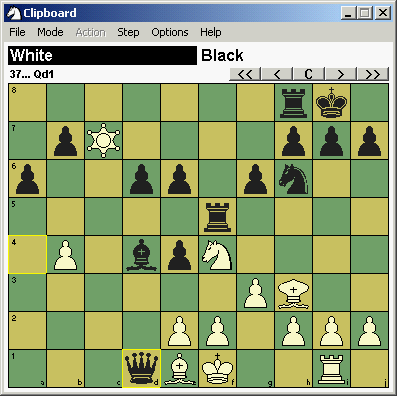
Joker80 allows its Bishop to be subject to an unsolvable pin.
Joker does not have any penalty in its evaluation for pinned pieces, which I do consider as one of its major sources of weakness. It thus regularly exposes a Knight or Bishop to such an unsolvable pin, abusing it as a lateral King shield. All black has to do is direct its Bishop and Knight against this permanently pinned Bishop, and white is canned dogmeat. It takes some time (which is why it is initially outside the horizon), but in the long run it is unavoidable.
In conclusion: a combination of strategic mistakes (not castling and trapping its Rook, not developing its Archbishop, and exposing its Bishop to a pin) caused Joker to throw away the game from a superior position. The errors can be traced to poor castling code, lack of mobility evaluation, and insufficient poor man's solutions (PST or trapped-piece code) to compensate for this, and not evaluating pins.
Code: Select all
[Event "Computer Chess Game"]
[Site "SCHAAK_PC"]
[Date "2008.04.06"]
[Round "4.1"]
[White "Joker80 n"]
[Black "Smirf 1.73g-X"]
[Result "0-1"]
[TimeControl "3300+5"]
[Variant "capablanca"]
[FEN "rnbqckabnr/pppppppppp/10/10/10/10/PPPPPPPPPP/RNBQCKABNR w KQkq - 0 1"]
[SetUp "1"]
[Number "25"]

{--------------
r n b q c k a b n r
p p p p p p p p p p
. . . . . . . . . .
. . . . . . . . . .
. . . . . . . . . .
. . . . . . . . . .
P P P P P P P P P P
R N B Q C K A B N R
white to play
--------------}
1. Cf3 Cf6 2. Cd4 Cd5 3. Cb5 Cb4 4. Cc3 Cc6 5. Qe1 Qe8 6. Cd1 Cd8
{ Engines start to play from here: }
7. d4 {+0.07/12 1:01} d6 {-0.40/10 1:23} 8. g3 {+0.03/12 1:19}
Nh6 {-0.17/10 2:13} 9. Nh3 {+0.04/11 51} g6 {-0.22/10 2:29} 10.
Nc3 {+0.05/11 48} Bf5 {-0.21/10 1:43} 11. Nd5 {+0.11/12 1:03}
Na6 {+0.00/11 2:26} 12. Bg5 {+0.14/12 1:41} f6 {+0.00/10 58} 13.
Bd2 {+0.07/11 56} Bg7 {-0.13/10 2:25} 14. Bg2 {+0.09/10 50}
c6 {-0.01/10 1:35} 15. Ne3 {+0.04/13 1:03} Be6 {-0.09/11 1:54} 16.
c4 {+0.13/11 1:03} Bxc4 {+0.61/12 1:11} 17. Nxc4 {+0.18/13 1:09}
Axc4 {+0.70/10 24} 18. d5 {+0.18/12 44} O-O {+0.90/11 1:15} 19.
Rc1 {+0.38/14 1:57} Axa2 {+1.43/12 1:08} 20. Ce3 {+1.04/13 44}
Axc1 {+1.38/11 1:02} 21. Qxc1 {+2.33/13 1:01} cxd5 {+1.28/10 1:06} 22.
Cxd5 {+2.28/12 1:14} Rc8 {+1.20/11 1:46} 23. Qb1 {+2.29/12 1:00}
Rc5 {+1.19/11 1:51} 24. Cd3 {+2.42/12 1:23} Rb5 {+1.41/10 1:05} 25.
Ca3 {+2.37/11 34} f5 {+1.07/10 1:18} 26. b3 {+2.23/12 1:24}
e6 {+1.15/10 1:33} 27. Qc2 {+2.20/12 43} Qd7 {+1.48/10 1:54} 28.
Ri1 {+2.16/11 52} Cc8 {+2.00/10 1:30} 29. Qd1 {+1.68/12 41}
Nc5 {+2.05/10 59} 30. b4 {+1.55/13 52} Ne4 {+1.75/11 1:38} 31.
Bxe4 {+1.31/13 1:10} fxe4 {+1.77/9 16} 32. Qa4 {+1.31/11 45}
a6 {+1.79/10 52} 33. Nf4 {+1.14/12 2:02} Cc7 {+2.40/9 1:22} 34.
Ah3 {+1.54/11 58} Bd4 {+2.02/9 42} 35. Cc2 {+1.54/11 53} Rf5 {+2.17/11 58}
36. Cxc7 {+1.38/13 59} Qxa4 {+2.19/10 28} 37. Be1 {+1.04/12 48}
Qd1 {+2.25/11 1:00} 38. Cxe6 {+0.93/12 32} Bc3 {+2.28/10 53} 39.
Ng2 {+0.56/12 38} d5 {+2.64/10 35} 40. Cc7 {+0.38/12 38} Bxb4 {+2.94/11 44}
41. Cg7+ {+0.44/12 15} Kj8 {+2.95/9} 42. Cxb7 {+0.00/13 37}
a5 {+2.72/10 28} 43. i4 {+0.00/12 30} Rf7 {+3.32/10 21} 44.
Cb6 {-3.31/13 52} Rhf8 {+3.17/10 20} 45. Ce6 {-3.34/12 47} Nf5 {+3.25/9 15}
46. Ag5 {-3.51/12 45} Nd4 {+5.57/10 13} 47. Cxf8+ {-4.68/12 18} Bxf8 48.
Nf4 {-4.73/12 13} Nc2 {+7.19/11 12} 49. Kg2 {-4.91/12 20} Ra7 {+7.31/11 12}
50. Kh3 {-5.13/11 22} Nxe1 {+7.28/11 18} 51. Af6 {-5.54/12 39}
Bb4 {+7.29/10 17} 52. Nxd5 {-5.74/11 11} Rf7 {+8.52/10 11} 53.
Ag8 {-4.01/12 30} Qxd5 {+14.10/10 19} 54. Rxe1 {-10.14/11 18}
Bxe1 {+16.55/12 9} 55. Axf7 {-17.96/10 1:04} Qxf7 {+18.23/13 9} 56.
Ki2 {-22.36/10 32} a4 {+23.17/13 19} 57. f3 {-23.46/10 13} Qe6+ {+24.50/11}
58. g4 {-23.33/10 15} a3 {+24.72/10 0} 59. j4 {-24.38/10 29} a2 60.
j5 {-26.11/9 6} a1=C 61. j6 {-100.05/10 15} Bxj6 62. h3 {-100.04/8 0} exf3
63. Ki3 {-100.03/6 0} fxe2 64. Kj2 {-100.03/6 0} e1=Q 65. i5 {-100.03/6 0}
Bxi5 66. Ki3 {-100.03/6 0} Qi1+ 67. Kj3 {-100.02/4 0} Qxg4 68.
hxg4 {-100.01/2 0} Cb3#
{Xboard adjudication: Checkmate} 0-1
Joker subsequently does spoil its advantage by passive play, destroying its castling rights (and thus leaving its own Rook trapped) for no visible reason, and leaving its Archbishop (the reason it is ahead) passively hidden behind its own King. Joker has no mobility evaluation, and no Piece-Square Tables, and the Archbishop is not even attracted by the center. The latter is probably a mistake; Joker (like uMax) only attracts pieces less valuable than a Rook to the center, based on the assumption that the others are too valuable, and thus susceptible to attack, to put them there. In particular, I leave the super-pieces free to roam the board. For the Queen this always worked well, but an Archbishop is a combination of two pieces that both benefit in mobility by centralization. I guess a PST that penalizes A from being on an edge square, but leaving all other squares equal, would solve most of the problem.
The decisive error is that Joker allows its Bishop to be pinned, using it as a King shield:
Joker80 allows its Bishop to be subject to an unsolvable pin.
Joker does not have any penalty in its evaluation for pinned pieces, which I do consider as one of its major sources of weakness. It thus regularly exposes a Knight or Bishop to such an unsolvable pin, abusing it as a lateral King shield. All black has to do is direct its Bishop and Knight against this permanently pinned Bishop, and white is canned dogmeat. It takes some time (which is why it is initially outside the horizon), but in the long run it is unavoidable.
In conclusion: a combination of strategic mistakes (not castling and trapping its Rook, not developing its Archbishop, and exposing its Bishop to a pin) caused Joker to throw away the game from a superior position. The errors can be traced to poor castling code, lack of mobility evaluation, and insufficient poor man's solutions (PST or trapped-piece code) to compensate for this, and not evaluating pins.
-
hgm
- Posts: 28458
- Joined: Fri Mar 10, 2006 10:06 am
- Location: Amsterdam
- Full name: H G Muller
Re: 10x8 WB - Archbishop values and sacrifices
Another interesting game is BigLion80 - Joker80:
After 27. Bxa7, the need of white to prevent the trapping of its Bishop allows black to initiate a very long and complicated tactical sequence, trading Bishops and Knights, and A+R vs Q+N. BigLion apparently thinks the latter an equal exchange, and thus counts itself rich (+1.12) with the a-Pawn it grabbed. Joker has A only slightly less valuable than Q, and thus is happy with a (R-N)exchange for a Pawn (+1.25).
After the exchange of one more Rook, the following position occurs, where the white King safety has suffered somewhat more than the black. But this close to the end-game, with the opponent having no Queen and only A+R, King safety doesnt weigh that heavy, not?
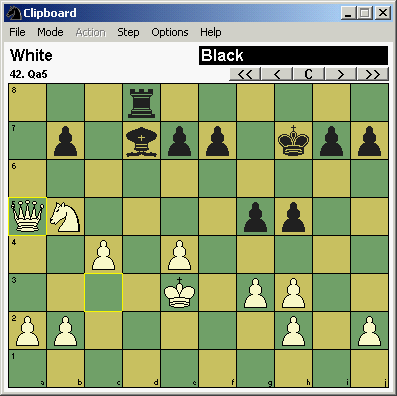
This innocently looking Q+N+P vs A+R end-game is in fact devastatingly won by black.
White's 42. Qa5 attacks black's undefended Rook, in an attempt to force it away from the open file. However, the Archbishop explodes into action, launching a devastating pursuit on the white King, harrassing it with checks, eating some Pawns in the process, until it finally has driven it to a square where black can engage its g-Pawn against it (48. ..., g4+).
Of course it does not help for white that he searches about 5 ply less deep than black (although I don't know how they apply check extensions, so it might not be fair comparison). White tries to find shelter behind its Pawns, but in the end cannot avoid that black can involve its (still hanging) Rook with check.
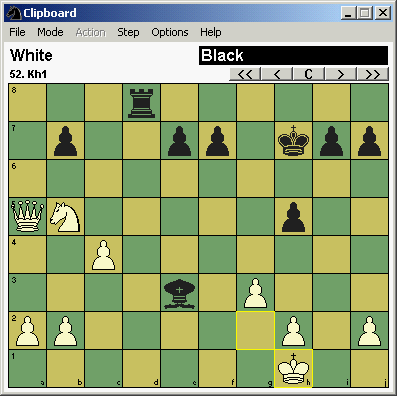
Joker80 finally gets the opportunity to engage its hanging Rook, and announces mate in 8.
With the assistance of the Rook, Joker80 gets the checkmate within the search horizon, and quickly finishes the game. A good illustration of the extreme danger an Archbishop can pose to a shelterless King.
Code: Select all
[Event "Computer Chess Game"]
[Site "SCHAAK_PC"]
[Date "2008.04.07"]
[Round "5.1"]
[White "BigLion80 4apr"]
[Black "Joker80 n"]
[Result "0-1"]
[TimeControl "3300+5"]
[Variant "capablanca"]
[FEN "rnbqckabnr/pppppppppp/10/10/10/10/PPPPPPPPPP/RNBQCKABNR w KQkq - 0 1"]
[SetUp "1"]
[Number "33"]

{--------------
r n b q c k a b n r
p p p p p p p p p p
. . . . . . . . . .
. . . . . . . . . .
. . . . . . . . . .
. . . . . . . . . .
P P P P P P P P P P
R N B Q C K A B N R
white to play
--------------}
1. Cf3 Cf6 2. Cd4 Cd5 3. Cb5 Cb4 4. Cc3 Cc6 5. Qe1 Qe8 6. Cd1 Cd8 7.
d4 {-0.18/8 1:00} g6 {+0.00/13 2:34} 8. Nh3 {+0.07/7 58} d5 {+0.09/12 1:26}
9. g3 {-0.22/7 57} Bf5 {+0.04/11 1:24} 10. c3 {-0.49/6 5} h6 {+0.14/11 44}
11. f3 {+0.17/7 53} g5 {+0.18/11 2:11} 12. e4 {+0.34/7 55}
dxe4 {+0.28/12 2:03} 13. fxe4 {+0.12/6 5} Bh7 {+0.33/11 1:11} 14.
Na3 {+0.16/6 26} c5 {+0.28/11 2:04} 15. dxc5 {+1.16/8 54}
Cxd1 {+0.30/11 1:15} 16. Qxd1 {+1.17/7 18} Nc6 {+0.28/11 39} 17.
Bf3 {+1.06/6 5} Ne5 {+0.45/12 1:46} 18. Bg2 {+0.97/6 12}
Rd8 {+0.50/12 1:45} 19. Qc2 {+0.99/7 41} Qc6 {+0.50/11 33} 20.
Nf2 {+0.57/6 30} Qxc5 {+0.50/11 1:37} 21. Nh3 {+0.22/6 24}
Qd6 {+0.69/11 40} 22. Be3 {+0.21/7 50} Qa6+ {+1.05/10 39} 23.
Ae2 {+0.37/6 5} Ng4 {+0.91/11 27} 24. Bg1 {+0.44/6 9} Qf6+ {+0.81/12 38}
25. Ke1 {-0.01/6 3} Bi6 {+0.95/12 1:07} 26. Af1 {+0.16/6 11}
Ne5 {+1.03/11 33} 27. Bxa7 {+0.69/7 1:10} Bf3 {+1.51/11 40} 28.
Bd4 {+0.88/7 1:24} Bxg2 {+1.34/13 1:08} 29. Bxe5 {+0.81/6 0}
Qxf1+ {+1.25/14 30} 30. Rxf1 Bxf1 {+1.25/15 1:00} 31. Bxh8 {+1.23/8 29}
Bxh3 {+1.19/14 52} 32. ixh3 {+1.28/7 1} Ng7 {+1.25/14 35} 33.
Bxg7+ {+1.31/7 4} Kxg7 {+1.25/1 2:01} 34. c4 {+1.12/8 1:24}
Af6 {+1.96/12 25} 35. Nb5 {+0.60/8 1:20} Ae5 {+2.07/12 24} 36.
Ke2 {+1.09/8 1:15} Rd7 {+2.04/11 22} 37. Rd1 {+0.68/7 35}
Rxd1 {+2.31/14 33} 38. Kxd1 {+0.59/7 0} Rd8+ {+2.44/13 31} 39.
Ke2 {+0.00/9 37} h5 {+2.51/13 1:17} 40. Ke3 {+0.62/7 22} Ad7 {+3.13/12 31}
41. Qc3+ {+0.28/7 23} Kh7 {+3.30/12 33} 42. Qa5 {-0.48/8 1:09}
Ac5+ {+3.69/13 25} 43. Ke2 {-0.27/8 14} Ag1+ {+4.20/14 1:14} 44.
Ke1 {-0.54/8 11} Af3+ {+4.20/13 1:18} 45. Kf2 {-0.66/8 8}
Axe4+ {+4.36/13 1:12} 46. Ke3 {-1.23/9 1:12} Ac5+ {+4.51/13 42} 47.
Ke2 {-1.60/9 1:09} Ad3+ {+4.52/13 1:02} 48. Kf3 {-1.60/9 1:08}
g4+ {+4.74/13 30} 49. hxg4 {-0.91/8 1:05} Ae5+ {+4.83/13 54} 50.
Kf2 {-0.97/8 1:04} Axg4+ {+5.22/13 27} 51. Kg2 {-0.92/7 3}
Ae3+ {+4.84/13 35} 52. Kh1 {-1.34/8 1:02} Rd1+ {+100.08/11 10} 53.
Ki2 {-17.65/8 59} Af5+ {+100.06/12 13} 54. g4 {-309.84/6 5}
hxg4 {+100.05/11} 55. Qe1 {-309.88/6 9} Rxe1 {+100.04/9} 56.
h4 {-309.87/2 0} Ag3+ {+100.03/7} 57. Kj3 {-309.94/4 0} Ri1 {+100.02/5} 58.
Kj4 {-309.96/2 0} Ah5+ {+100.01/3} 59. Kj5 i6# {+100.00/1}
{Xboard adjudication: Checkmate} 0-1
After the exchange of one more Rook, the following position occurs, where the white King safety has suffered somewhat more than the black. But this close to the end-game, with the opponent having no Queen and only A+R, King safety doesnt weigh that heavy, not?
This innocently looking Q+N+P vs A+R end-game is in fact devastatingly won by black.
White's 42. Qa5 attacks black's undefended Rook, in an attempt to force it away from the open file. However, the Archbishop explodes into action, launching a devastating pursuit on the white King, harrassing it with checks, eating some Pawns in the process, until it finally has driven it to a square where black can engage its g-Pawn against it (48. ..., g4+).
Of course it does not help for white that he searches about 5 ply less deep than black (although I don't know how they apply check extensions, so it might not be fair comparison). White tries to find shelter behind its Pawns, but in the end cannot avoid that black can involve its (still hanging) Rook with check.
Joker80 finally gets the opportunity to engage its hanging Rook, and announces mate in 8.
With the assistance of the Rook, Joker80 gets the checkmate within the search horizon, and quickly finishes the game. A good illustration of the extreme danger an Archbishop can pose to a shelterless King.
-
hgm
- Posts: 28458
- Joined: Fri Mar 10, 2006 10:06 am
- Location: Amsterdam
- Full name: H G Muller
Re: 10x8 WB - Archbishop values and sacrifices
The last game of cycle #2 also had an interesting issue of material evaluation, this time not involving the Bishop pair:
This time the Archbishops are the first pieces to be traded. Fairy-Max, playing the white pieces, is a bit reluctant pushing its Pawns, and allows black to conquer a lot of space. After white's 22nd move, this brings the following position on the board:
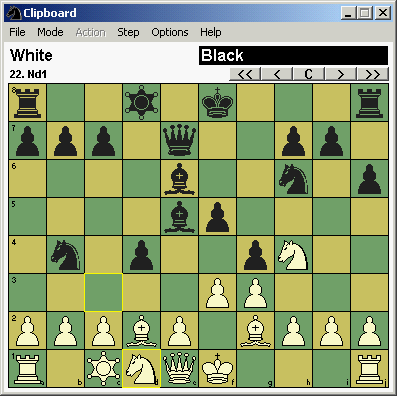
TJchess10x8 voluntarily initiates a trade that should be considered a horrible blunder: 22. ..., Nxa2 23. Rxa2, Bxa2 24. Cxa2. This leaves TJchess' score around +0.3, while Fairy-Max jumps from ~0 to +1.34. Black gives N+B for R+P, where its B was part of a pair. In normal Chess an N+N vs B+P trade is already a real lemon. N+B would be worse, when it destroys the B-pair. But in 10x8 Chess it is even worse than that, as even lone Bishops are worth half a Pawn more than Knights, and Pawns are worth less than in normal Chess. So this trade destroys indeed nearly 150cP worth of value for TJchess10x8.
TJchess must have its B value too low, as on move 27 it allows its remainig Bishop to be traded for a white Knight. By that time the material imbalance is a Bishop-pair against R+P, which Fairy-Max justly evaluates as ~+1.5, but TJchess10x8 still considers about equal (+0.23).
TJchess10x8, being in principle the much stronger engine (especially positionally, but also tactically), still tries to exert pressure on white through a Q+C+R battery on the half-open e-file before white has castled, and creates an a-file passer. But when white finally castles to safety, and starts to push Pawns against the black King fortress, the exchange of Pawns creates open space for the Bishop pair to unleash its full power against the exposed black King.
White then engages its Chancellor, which is traded against the defending one (47. Cxi5+, hxi5), after which all Capablanca pieces have been captured, leaving a normal Chess game on an unusually large board:
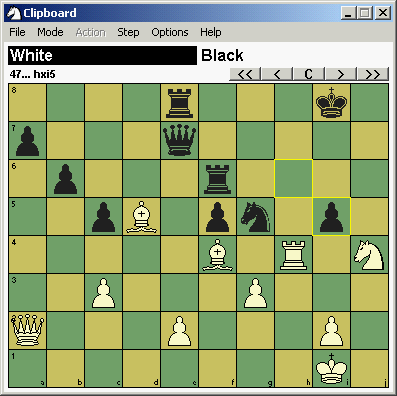
By this time TJchess10x8 already realizes that it is in big trouble (-2.77), as he is going to lose another Knight. Black gets furthermore under severe time pressure by one fail low after another, as the superior white army (B+B+N against R) makes its defenses crumble. Fairy-Max is not that bad a searcher that it could not finish off such a situation, and with the black time pressure compensating black's naturally larger search depth, sees its score rise on every move. White avoids trading Queens until it has gobbled up most black Pawns, until black finally has to give its Queen through a Bishop pin in order to delay mate, and resigns.
Code: Select all
[Event "Computer Chess Game"]
[Site "SCHAAK_PC"]
[Date "2008.04.08"]
[Round "7.4"]
[White "Fairy-Max 4.8 v"]
[Black "TJchess10x8"]
[Result "1-0"]
[TimeControl "3300+5"]
[Variant "capablanca"]
[FEN "rnbqckabnr/pppppppppp/10/10/10/10/PPPPPPPPPP/RNBQCKABNR w KQkq - 0 1"]
[SetUp "1"]
[Number "56"]

{--------------
r n b q c k a b n r
p p p p p p p p p p
. . . . . . . . . .
. . . . . . . . . .
. . . . . . . . . .
. . . . . . . . . .
P P P P P P P P P P
R N B Q C K A B N R
white to play
--------------}
1. Cf3 Cf6 2. Cd4 Cd5 3. Cb5 Cb4 4. Cc3 Cc6 5. Qe1 Qe8 6. Cd1 Cd8
[ Engines start to play from here: }
7. Nc3 {+0.10/10 41} Na6 {-0.12/11 1:09} 8. d4 {-0.09/10 1:05}
Nh6 {-0.11/11 2:35} 9. Bf4 {-0.01/9 38} f6 {-0.02/11 1:02} 10.
Nh3 {-0.09/9 37} g5 {+0.07/12 2:35} 11. Bd2 {-0.26/10 48}
g4 {+0.12/11 1:24} 12. Ni5 {-0.14/10 2:16} f5 {+0.24/11 53} 13.
f3 {-0.19/9 1:12} Nb4 {+0.34/11 45} 14. Cc1 {-0.09/9 1:11}
j6 {+0.21/11 2:54} 15. Nj3 {-0.15/9 1:38} d5 {+0.26/10 1:13} 16.
Nh4 {-0.01/7 27} e5 {+0.23/10 1:46} 17. dxe5 {-0.18/7 30}
Bxe5 {+0.36/10 49} 18. Ac5+ {-0.05/6 37} Ae7 {+0.45/10 20} 19.
Axe7+ {-0.10/9 36} Qxe7 {+0.59/11 55} 20. g3 {-0.19/8 40} Be6 {+0.48/10 36}
21. Bg2 {+0.06/7 24} d4 {+0.71/11 42} 22. Nd1 {+0.01/8 38}
Nxa2 {+0.57/10 18} 23. Rxa2 {+1.34/11 54} Bxa2 {+0.37/10 23} 24.
Cxa2 {+1.02/9 22} c5 {+0.29/10 1:08} 25. Nf2 {+1.08/8 25}
O-O {+0.24/10 1:22} 26. Nd3 {+1.43/9 30} Ce6 {+0.21/10 48} 27.
Nxe5 {+1.44/9 42} Cxe5 {+0.23/10 26} 28. Bf4 {+1.40/9 46} Ce6 {+0.22/10 19}
29. Qd2 {+1.34/9 1:12} Rhf8 {+0.25/10 43} 30. Cc1 {+1.38/9 1:12}
Rae8 {+0.20/11 39} 31. c4 {+1.39/9 26} dxc3 {+0.26/11 29} 32.
bxc3 {+1.36/10 24} b6 {+0.42/9 16} 33. j4 {+1.34/10 28} Rd8 {+0.42/10 15}
34. Qa2 {+1.38/11 56} i6 {+0.41/9 24} 35. O-O {+1.52/10 1:06}
i5 {+0.27/11 32} 36. jxi5 {+1.31/11 32} jxi5 {-0.05/12 56} 37.
Nj3 {+1.33/11 25} gxf3 {-0.05/11 33} 38. Bxf3 {+1.38/12 37}
Ni4 {+0.14/11 56} 39. h4 {+1.51/11 44} ixh4 {-0.52/10 30} 40.
Rxh4 {+1.54/11 35} Ng5 {-0.52/10 18} 41. Ni5 {+1.89/11 1:55}
h6 {-0.89/10 28} 42. Nh3 {+1.77/10 46} Rf6 {-0.96/10 27} 43.
Bd5 {+1.75/11 23} Cg7 {-0.70/11 2:04} 44. Ch1 {+1.76/10 33}
Re8 {-1.39/10 58} 45. Nj4 {+2.63/10 14} Cg6 {-2.21/11 2:49} 46.
Ci3+ {+3.03/9 16} Ci5 {-2.72/13 2:39} 47. Cxi5+ {+3.54/13 17}
hxi5 {-2.77/14 1:16} 48. Bxg5 {+4.33/13 34} ixh4 {-2.83/13 48} 49.
Nh5 {+4.30/13 55} Qxe2 {-3.12/13 2:06} 50. Qxa7 {+4.19/12 20}
Re7 {-3.13/12 39} 51. Qb8+ {+4.53/12 16} Re8 {-4.28/14 1:28} 52.
Ng7+ {+4.54/12 10} Kh7 {-5.11/14 2:41} 53. Nxe8 {+5.69/12 17}
Qe1+ {-5.51/13 2:00} 54. Bh1 {+6.05/12 26} Rg6 {-6.21/13 1:17} 55.
gxh4 {+7.35/12 29} Qxc3 {-6.54/12 47} 56. Qc7+ {+7.97/13 19}
Rg7 {-7.47/12 5} 57. Nxg7 {+8.19/13 14} Qxg7 {-7.87/12 0} 58.
Qxb6 {+9.02/13 18} Qg6 {-8.67/11 12} 59. Qxc5 {+10.02/13 24}
Qe6 {-14.39/11 5} 60. Qc7+ {+18.77/13 22} Kg8 {-199.82/12 6} 61.
h5 {+19.35/14 21} Qf7 {-17.69/11 0} 62. Qd6 {+79.92/14 33}
f4 {-199.88/11 2} 63. Bd5 {+79.94/14 14} Qxd5 {-199.90/10}
{Black resigns} 1-0
TJchess10x8 voluntarily initiates a trade that should be considered a horrible blunder: 22. ..., Nxa2 23. Rxa2, Bxa2 24. Cxa2. This leaves TJchess' score around +0.3, while Fairy-Max jumps from ~0 to +1.34. Black gives N+B for R+P, where its B was part of a pair. In normal Chess an N+N vs B+P trade is already a real lemon. N+B would be worse, when it destroys the B-pair. But in 10x8 Chess it is even worse than that, as even lone Bishops are worth half a Pawn more than Knights, and Pawns are worth less than in normal Chess. So this trade destroys indeed nearly 150cP worth of value for TJchess10x8.
TJchess must have its B value too low, as on move 27 it allows its remainig Bishop to be traded for a white Knight. By that time the material imbalance is a Bishop-pair against R+P, which Fairy-Max justly evaluates as ~+1.5, but TJchess10x8 still considers about equal (+0.23).
TJchess10x8, being in principle the much stronger engine (especially positionally, but also tactically), still tries to exert pressure on white through a Q+C+R battery on the half-open e-file before white has castled, and creates an a-file passer. But when white finally castles to safety, and starts to push Pawns against the black King fortress, the exchange of Pawns creates open space for the Bishop pair to unleash its full power against the exposed black King.
White then engages its Chancellor, which is traded against the defending one (47. Cxi5+, hxi5), after which all Capablanca pieces have been captured, leaving a normal Chess game on an unusually large board:
By this time TJchess10x8 already realizes that it is in big trouble (-2.77), as he is going to lose another Knight. Black gets furthermore under severe time pressure by one fail low after another, as the superior white army (B+B+N against R) makes its defenses crumble. Fairy-Max is not that bad a searcher that it could not finish off such a situation, and with the black time pressure compensating black's naturally larger search depth, sees its score rise on every move. White avoids trading Queens until it has gobbled up most black Pawns, until black finally has to give its Queen through a Bishop pin in order to delay mate, and resigns.
-
TonyJH
- Posts: 183
- Joined: Tue Jun 20, 2006 4:41 am
- Location: USA
Re: 10x8 WB - Archbishop values and sacrifices
Good analysis, H.G.. That was an interesting game. I will have to improve the piece values of TJchess10x8, and hopefully make some other improvements as well. I will let the current version play out this tourney, though.
-
George Tsavdaris
- Posts: 1627
- Joined: Thu Mar 09, 2006 12:35 pm
Re: 10x8 WB - Archbishop values and sacrifices
Here i agree that the trade is bad but because of the position and only that and not because it is generally bad to trade B+N for R+P.hgm wrote: TJchess10x8 voluntarily initiates a trade that should be considered a horrible blunder: 22. ..., Nxa2 23. Rxa2, Bxa2 24. Cxa2. This leaves TJchess' score around +0.3, while Fairy-Max jumps from ~0 to +1.34. Black gives N+B for R+P, where its B was part of a pair. In normal Chess an N+N vs B+P trade is already a real lemon. N+B would be worse, when it destroys the B-pair. But in 10x8 Chess it is even worse than that, as even lone Bishops are worth half a Pawn more than Knights, and Pawns are worth less than in normal Chess. So this trade destroys indeed nearly 150cP worth of value for TJchess10x8.
Instead 22...Nc6 is better i guess.
In these middlegame positions where you have a very good mobility of Bishop and Knight in the center right into action, it is very very bad indeed to trade both these active pieces for a sleeping Rook and a Pawn.
Gothic Vortex 2.2.5(almost latest edition) liked Nxa2 too for a while, but rejected it after around 3.5 minutes for the not good also in my opinion( but definitely better than Nxa2), 2...a5.
I played against Joker in that position after 2...Nc6 and drew with a King attack since it is obvious that black has the control of the Kingside.
Just like you saw i did in GothicChessLive place as MTal, i did it this time also but this time i failed to win. Joker was too late to see the attack and this is a general problem of todays 10x8 programs.
It reported scores of +5.00 for more than 10 moves and scores of +12.42, +12.13 etc, but it only was able to draw.
In the final position i had 2 Rooks, a Bishop and a Knight plus 2 Pawns less! But i drew.

Note also that in the last few moves that were forced(but this is valid also for the other moves of the game) the times being reported was not correct, since for example for the move 48. Ki2 it says {+0.00/25 6}
that means 6 seconds were spent for making the move, but actually i counted(since i have spotted the problem earlier) 26 seconds!
These wrong time reports was true also as i've seen for moves 45,46,47 but as i see now, it is valid for the other moves of the game also, since Joker spent about 15 to 40 seconds for each move while if you see the times reported you will see very very low times of 1 to 5 seconds.
I don't know why this happened.**
The game:
Code: Select all
[Event "Computer Chess Game"]
[Site "USER"]
[Date "2008.04.09"]
[Round "-"]
[White "Joker80"]
[Black "George"]
[Result "1/2-1/2"]
[TimeControl "40/1200"]
[Variant "gothic"]
[Annotator "7. +0.10   7... +0.12"]

1. Cf3 Cf6 2. Cd4 Cd5 3. Cb5 Cb4 4. Cc3 Cc6 5. Qe1 Qe8 6. Cd1 Cd8 7.
Nc3 {+0.10/10 41} Na6 {+0.12/11 1:09} 8. d4 {+0.09/10 1:05}
Nh6 {+0.11/11 2:35} 9. Bf4 {+0.01/9 38} f6 {+0.02/11 1:02} 10.
Nh3 {+0.09/9 37} g5 {+0.07/12 2:35} 11. Bd2 {+0.26/10 48}
g4 {+0.12/11 1:24} 12. Ni5 {+0.14/10 2:16} f5 {+0.24/11 53} 13.
f3 {+0.19/9 1:12} Nb4 {+0.34/11 45} 14. Cc1 {+0.09/9 1:11}
j6 {+0.21/11 2:54} 15. Nj3 {+0.15/9 1:38} d5 {+0.26/10 1:13} 16.
Nh4 {+0.01/7 27} e5 {+0.23/10 1:46} 17. dxe5 {+0.18/7 30}
Bxe5 {+0.36/10 49} 18. Ac5+ {+0.05/6 37} Ae7 {+0.45/10 20} 19.
Axe7+ {+0.10/9 36} Qxe7 {+0.59/11 55} 20. g3 {+0.19/8 40} Be6 {+0.48/10 36}
21. Bg2 {+0.06/7 24} d4 {+0.71/11 42} 22. Nd1 {+0.01/8 38} Nc6 23.
Bxh6+ {+0.67/12 2} ixh6 24. fxg4 {+0.76/12 7} fxg4 25. O-O {+0.94/12 3} Cf7
26. Rf1 {+1.90/12 3} Bf6 27. c3 {+2.12/11 6} O-O 28. Bxc6 {+1.97/12 2} Kj7
29. Bxb7 {+5.19/14 2} Rab8 30. Bg2 {+5.15/13 4} h5 31. cxd4 {+7.17/12 1}
Ri8 32. d5 {+8.10/12 4} Bd7 33. Cxc7 {+8.55/12 2} Ch6 34. Bh1 {+9.46/11 1}
Ri4 35. e4 {+10.42/11 7} Bg5 36. Cxa7 {+11.18/11 6} Rbi8 37.
i3 {+12.42/10 8} Bxh4 38. gxh4 {+12.13/11 8} Rxi3+ 39. jxi3 {+10.59/13 2}
Rxi3+ 40. hxi3 {+0.00/17 1} Qe5+ 41. Ki2 {+0.00/17 1} Ci4 42.
Qd2 {+0.00/17 0} Qh2+ 43. Qxh2 {+0.00/22 2} g3+ 44. Cxd7 {+0.00/22 3} Cxh2+
45. Ki1 {+0.00/22 5} Ch3+ 46. Kj1 {+0.00/22 2} Ch2+ 47. Ki1 {+0.00/22 8}
Ch3+ 48. Ki2 {+0.00/25 6} 1/2-1/2
**And yes this is reproducible.
If i take the following:
Code: Select all
[Event "Computer Chess Game"]
[Site "USER"]
[Date "2008.04.09"]
[Round "-"]
[White "Joker80"]
[Black "George"]
[Result "*"]
[TimeControl "40/1200"]
[Variant "gothic"]
[Annotator "7. +0.10   7... +0.12"]

1. Cf3 Cf6 2. Cd4 Cd5 3. Cb5 Cb4 4. Cc3 Cc6 5. Qe1 Qe8 6. Cd1 Cd8 7.
Nc3 {+0.10/10 41} Na6 {+0.12/11 1:09} 8. d4 {+0.09/10 1:05}
Nh6 {+0.11/11 2:35} 9. Bf4 {+0.01/9 38} f6 {+0.02/11 1:02} 10.
Nh3 {+0.09/9 37} g5 {+0.07/12 2:35} 11. Bd2 {+0.26/10 48}
g4 {+0.12/11 1:24} 12. Ni5 {+0.14/10 2:16} f5 {+0.24/11 53} 13.
f3 {+0.19/9 1:12} Nb4 {+0.34/11 45} 14. Cc1 {+0.09/9 1:11}
j6 {+0.21/11 2:54} 15. Nj3 {+0.15/9 1:38} d5 {+0.26/10 1:13} 16.
Nh4 {+0.01/7 27} e5 {+0.23/10 1:46} 17. dxe5 {+0.18/7 30}
Bxe5 {+0.36/10 49} 18. Ac5+ {+0.05/6 37} Ae7 {+0.45/10 20} 19.
Axe7+ {+0.10/9 36} Qxe7 {+0.59/11 55} 20. g3 {+0.19/8 40} Be6 {+0.48/10 36}
21. Bg2 {+0.06/7 24} d4 {+0.71/11 42} 22. Nd1 {+0.01/8 38}Code: Select all
[Event "Computer Chess Game"]
[Site "USER"]
[Date "2008.04.09"]
[Round "-"]
[White "Joker80"]
[Black "George"]
[Result "*"]
[TimeControl "40/1200"]
[Variant "gothic"]
[Annotator "7. +0.10   7... +0.12"]

1. Cf3 Cf6 2. Cd4 Cd5 3. Cb5 Cb4 4. Cc3 Cc6 5. Qe1 Qe8 6. Cd1 Cd8 7.
Nc3 {+0.10/10 41} Na6 {+0.12/11 1:09} 8. d4 {+0.09/10 1:05}
Nh6 {+0.11/11 2:35} 9. Bf4 {+0.01/9 38} f6 {+0.02/11 1:02} 10.
Nh3 {+0.09/9 37} g5 {+0.07/12 2:35} 11. Bd2 {+0.26/10 48}
g4 {+0.12/11 1:24} 12. Ni5 {+0.14/10 2:16} f5 {+0.24/11 53} 13.
f3 {+0.19/9 1:12} Nb4 {+0.34/11 45} 14. Cc1 {+0.09/9 1:11}
j6 {+0.21/11 2:54} 15. Nj3 {+0.15/9 1:38} d5 {+0.26/10 1:13} 16.
Nh4 {+0.01/7 27} e5 {+0.23/10 1:46} 17. dxe5 {+0.18/7 30}
Bxe5 {+0.36/10 49} 18. Ac5+ {+0.05/6 37} Ae7 {+0.45/10 20} 19.
Axe7+ {+0.10/9 36} Qxe7 {+0.59/11 55} 20. g3 {+0.19/8 40} Be6 {+0.48/10 36}
21. Bg2 {+0.06/7 24} d4 {+0.71/11 42} 22. Nd1 {+0.01/8 38} Nc6 23.
Bxh6+ {+0.58/10 3}
*
After his son's birth they've asked him:
"Is it a boy or girl?"
YES! He replied.....
"Is it a boy or girl?"
YES! He replied.....
-
hgm
- Posts: 28458
- Joined: Fri Mar 10, 2006 10:06 am
- Location: Amsterdam
- Full name: H G Muller
Re: 10x8 WB - Archbishop values and sacrifices
Yes, Guenther also already complained about the wrong times WinBoard_F seems to report. I rcently changed something there, but apparently I goofed. I will fix it as soon as I have time again to work on WinBoard_F.
I find that having R+P in stead of N+N early in the game (all other things being equal) reduces your win probability by about 15% or so, and I would say that makes it a bad trade. And I also find that having N+B+P in stead of B+B early on is about even, suggesting that giving the first Bishop of your pair in stead of a Knight nearly makes it a full Pawn worse. I only measured material imbalances early in the game (except for A vs R+N+P), so I couldn't make any predictions of how such a trade would work out later. Obviously if N+N and B+P is the only material left, B+P might still win, while N+N would not even win if the B+P were given away for free. But I consider that more the result of a general correction that says you take a big hit (eval-wise) if you have no Pawns left.
Indeed you exposed a weakness of Joker80 (currently shared by the other engines), that it sees no problem in abandoning its King, allowing you to set up an "ambush" just over the horizon, by quickly moving your heavy pieces close to the vicinity of Joker's King. I think this can be fixed by including a 'tropism' term in the evaluation.
I find that having R+P in stead of N+N early in the game (all other things being equal) reduces your win probability by about 15% or so, and I would say that makes it a bad trade. And I also find that having N+B+P in stead of B+B early on is about even, suggesting that giving the first Bishop of your pair in stead of a Knight nearly makes it a full Pawn worse. I only measured material imbalances early in the game (except for A vs R+N+P), so I couldn't make any predictions of how such a trade would work out later. Obviously if N+N and B+P is the only material left, B+P might still win, while N+N would not even win if the B+P were given away for free. But I consider that more the result of a general correction that says you take a big hit (eval-wise) if you have no Pawns left.
Indeed you exposed a weakness of Joker80 (currently shared by the other engines), that it sees no problem in abandoning its King, allowing you to set up an "ambush" just over the horizon, by quickly moving your heavy pieces close to the vicinity of Joker's King. I think this can be fixed by including a 'tropism' term in the evaluation.
-
hgm
- Posts: 28458
- Joined: Fri Mar 10, 2006 10:06 am
- Location: Amsterdam
- Full name: H G Muller
Re: Announcement: Open 10x8 WB engine tournament
The third cycle of this turney seems to qualify as the cycle of bugs and blunders. In the game Joker80 - Smirf Bonus, it seems like the A vs R+B end-game is going for a dead draw, when Joker80 for no apparent reason suddenly walks with its King into a 'mate tunnel' in the j-file, where nothing can be achieved, and where it is just a matter of time before the black Rook can threaten mate, so that white has to give its Archbishop for it. With a Bishop against Pawns this leaves a trivial win for Smirf.
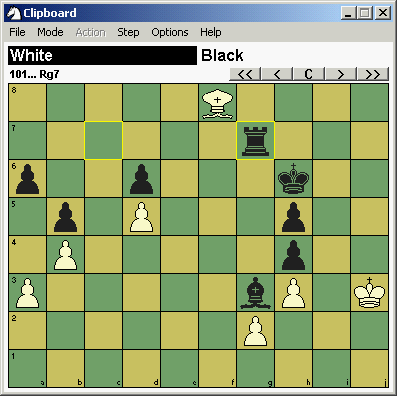
Moving the white King to j6, like Joker80 did, is not a good idea...
Then it was Smirf's turn to blunder, against Fairy-Max. With Fairy-Max already seeing that it will be mated in 7 in an end-game of Smirf (black)'s Q+5P against A+2P, with one of Smirf's passers close to promotion, and the black King safely tugged away behind Pawns, Smirf (playing from the hash table, as it has already seen the mate) suddenly blunders away his Queen by checking on a square that was covered by the white Archbishop (55. ..., Qe8+?). After that, black (with only Pawns against an Archbishop) is toast.
If giving away a Queen in stead of mating-in-6 already sounds bad, Joker80 managed to top it in its game against Smirf Donation. It forfeited on time in a position where it could mate in one! On the move before it had to promote to Chancellor to do that, and apparently I did not correctly fix the under-promotion bug (which caused the chosen piece to be replaced by a Queen at the instant the move was executed). So in stead of being surprised by having a Queen in stead of the chosen Chancellor, it now crashed.
A very weird game was Smirf Donation - Joker80:
Here Joker80 severely underestimated the white threat of the centralized super-pieces against its uncastled King:
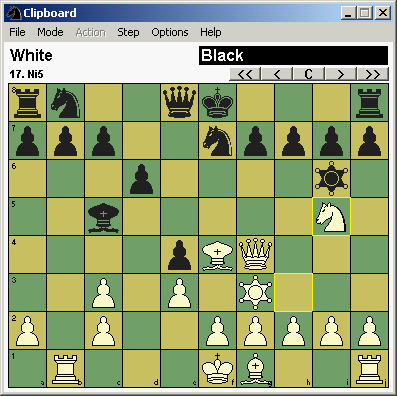
Only after 17. Ni5 the magnitude of the disaster becomes apparent, and Joker80 barely manages to evacuate its King, basically at the expense of its entire King-side worth of Pawns, and unfavorably trading some super-pieces. After Smirf has nine Pawns against Joker80's four, and on top of that has two stronger pieces (C vs A and B vs N), together also an advantage of about a Pawn. Perhaps Smirf's +8.93 is a bit exaggerated, but even Joker80 is at -5.69 here:
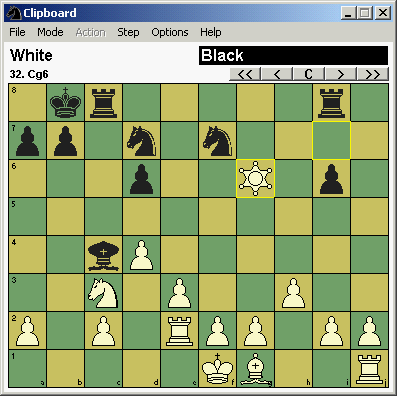
Perhaps Smirf could have overrun Joker80 here by a massive Pawn assault on the King side, and, having used much more time than Joker80, and being under severe time presure, did not have the depth to get the promotions within the horizon. Or perhaps Smirf saw it right, and advancing the Pawns would simply lead to their demise by the hand of black's Archbishop. (The latter is very efficient for gobbling up Pawns.)
In stead Smirf decides to castle,and trade its Knight for the last black King-side Pawn, creating 5 (!) connected passers, which, however, also act as Pawn-shield for its King. Black has much difficulty to free its pieces, which initially all have to defend each other against white's Chancellor in an extremely cumbersome way, almost like a sliding puzzle. The black Archbishop continues to harass the white Chancellor, and as black liberates its pieces bit by bit, Smirf's score slowly drops, and Joker80's score rises to -1.33. Then Smirf, now under very heavy time pressure and therefore outsearched by 2-3 ply, makes a decisive error, and loses heavy material.
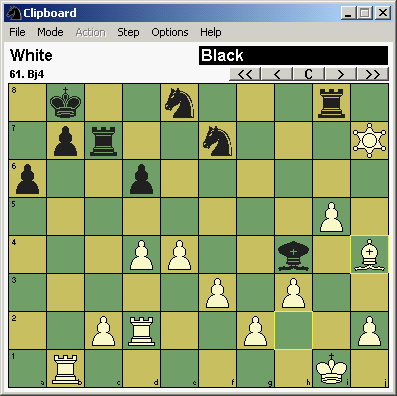

After 62. Kj1 Af4 the white Rook hangs, and defending it gives black the opportunity to attack and pin the white Chancellor on the white Bishop (63. Rd1, Rj8). White cannot afford to lose the Bishop, which is crucial for the defense of h2, and gives its Chancellor for the Rook (64. Cxj8, Axj8). Joker80's score is back in the positive region (+1.73) after this, although Smirf still values its own position as +2.53.
Black can now also start pushing its few remaining Pawns, and its majority in pieces (ANN vs RB) can efficiently block the white passer advance. The Archbishop single-handedly subdues the R+B while the Knights are blocking the Pawns, and finally the agile Archbishop clears the board of most white Pawns. When it then pushes its own passer, so that white have to give its Rook for it, it is "game over" for Smirf, and Joker80 has successfully come back from the dead!
Moving the white King to j6, like Joker80 did, is not a good idea...
Then it was Smirf's turn to blunder, against Fairy-Max. With Fairy-Max already seeing that it will be mated in 7 in an end-game of Smirf (black)'s Q+5P against A+2P, with one of Smirf's passers close to promotion, and the black King safely tugged away behind Pawns, Smirf (playing from the hash table, as it has already seen the mate) suddenly blunders away his Queen by checking on a square that was covered by the white Archbishop (55. ..., Qe8+?). After that, black (with only Pawns against an Archbishop) is toast.
If giving away a Queen in stead of mating-in-6 already sounds bad, Joker80 managed to top it in its game against Smirf Donation. It forfeited on time in a position where it could mate in one! On the move before it had to promote to Chancellor to do that, and apparently I did not correctly fix the under-promotion bug (which caused the chosen piece to be replaced by a Queen at the instant the move was executed). So in stead of being surprised by having a Queen in stead of the chosen Chancellor, it now crashed.
A very weird game was Smirf Donation - Joker80:
Code: Select all
[Event "Computer Chess Game"]
[Site "SCHAAK_PC"]
[Date "2008.04.11"]
[Round "6.3"]
[White "Smirf Donation"]
[Black "Joker80 n"]
[Result "0-1"]
[TimeControl "3300+5"]
[Variant "capablanca"]
[Annotator "1. +0.27   1... +0.00"]
[Number "36"]

1. Nh3 {+0.27/11 1:32} e5 {+0.00/11 29} 2. Ad3 {+0.12/11 1:41}
e4 {+0.21/11 34} 3. Af4 {+0.76/11 1:27} Nh6 {+0.24/11 47} 4.
Nc3 {+0.60/11 1:26} f5 {+0.25/11 1:02} 5. d3 {+0.65/10 1:25}
d6 {+0.29/11 1:10} 6. e3 {+0.50/10 1:21} Bf6 {+0.30/10 30} 7.
dxe4 {+0.86/9 1:08} Bc4+ {+0.57/11 43} 8. Be2 {+0.90/10 1:29}
Bxe2+ {+0.18/12 2:22} 9. Qxe2 {+1.08/11 1:28} Bxc3 {+0.18/12 2:14} 10.
bxc3 {+0.94/10 1:30} fxe4 {+0.02/12 2:06} 11. Cg3 {+1.08/10 1:24}
Nf5 {+0.43/11 1:07} 12. Cg4 {+1.51/11 1:17} Nh6 {+0.23/11 1:57} 13.
Cg5 {+1.62/10 1:27} Nf7 {+0.04/11 49} 14. Cg3 {+2.22/9 1:08}
Ad7 {+0.00/11 1:48} 15. Rb1 {+1.91/9 1:21} Ac5 {-0.01/10 44} 16.
Qg4 {+3.68/9 1:15} Ci6 {-0.44/9 30} 17. Ni5 {+4.24/10 1:23}
Ke7 {-3.43/10 54} 18. Nxh7 {+4.54/9 1:02} Rg8 {-2.70/10 31} 19.
Ad5+ {+5.11/9 1:25} Kd8 {-3.23/12 28} 20. Qxi6 {+5.34/10 1:02}
jxi6 {-3.72/12 1:05} 21. Nf6 {+6.46/11 1:01} c6 {-3.98/12 36} 22.
Nxe8 {+6.69/13 1:27} cxd5 {-4.28/13 1:30} 23. Nf6 {+7.01/13 1:38}
Aa3 {-5.60/13 1:41} 24. Re1 {+7.29/13 1:21} Ac4+ {-4.96/12 42} 25.
Re2 {+8.51/14 1:39} d4 {-5.22/12 25} 26. cxd4 {+8.42/13 1:21}
Rf8 {-5.84/12 48} 27. Cxg7 {+8.56/12 1:28} Nd7 {-6.13/11 34} 28.
Nxe4 {+8.61/11 1:17} Kc7 {-6.11/11 36} 29. Nc3 {+8.51/11 1:15}
Rac8 {-5.66/11 26} 30. Cxi7 {+8.67/11 1:23} Kb8 {-5.68/12 1:10} 31.
h3 {+8.81/11 1:02} Ri8 {-5.69/11 19} 32. Cg6 {+8.93/11 42}
Aa6 {-4.89/12 25} 33. Cg7 {+7.50/13 1:32} Rif8 {-3.46/13 54} 34.
Bh2 {+6.52/12 48} Ka8 {-3.38/12 48} 35. O-O {+5.88/12 43}
Rxc3 {-3.39/13 27} 36. Rhe1 {+6.27/11 28} Ab4 {-3.29/12 21} 37.
Cxi6 {+6.57/10 26} Axa2 {-3.64/12 1:04} 38. Cg7 {+6.28/10 34}
Ab4 {-3.33/11 29} 39. Bj4 {+6.53/9 23} Ac6 {-3.57/12 32} 40.
Ra1 {+6.56/10 49} Rj8 {-3.11/11 25} 41. Bh2 {+6.54/9 18} Ae7 {-3.30/12 58}
42. i3 {+6.75/9 26} Nf6 {-3.39/12 1:05} 43. Bf4 {+6.98/10 22}
Rf8 {-3.41/12 21} 44. e4 {+7.08/9 15} Rcc8 {-3.37/11 23} 45.
f3 {+7.23/8 18} Ac6 {-3.42/11 22} 46. Rd2 {+7.33/9 12} Ae8 {-3.41/12 54}
47. Cf5 {+7.13/9 16} a6 {-3.46/12 1:05} 48. i4 {+6.97/9 14}
Ad7 {-3.33/11 16} 49. Cg7 {+7.12/9 17} Ne8 {-3.33/11 14} 50.
Ci7 {+7.13/9 16} Ae6 {-3.28/11 8} 51. Be3 {+7.04/10 13} Kb8 {-3.32/11 18}
52. i5 {+7.17/8 10} Rh8 {-3.22/11 31} 53. Rb1 {+7.09/8 11}
Rc7 {-3.06/11 26} 54. Cg6 {+6.49/9 9} Ag7 {-2.76/12 14} 55. Bf4 {+6.23/9 4}
Ah5 {-2.61/12 13} 56. Ch4 {+5.30/10 12} Af6 {-2.56/12 26} 57.
Cj5 {+5.26/10 5} Ah5 {-2.55/11 12} 58. Bh2 {+5.03/10 5} Ai6 {-2.64/11 7}
59. Cj6 {+4.80/10 7} Ah4 {-1.47/11 4} 60. Cj7 {+4.61/9 4} Ri8 {-1.33/11 11}
61. Bj4 {+3.14/9 4} Ag3+ {+1.73/13 19} 62. Kj1 {+3.21/11 9}
Af4 {+1.61/13 44} 63. Rbd1 {+2.99/11 6} Rj8 {+1.75/13 6} 64.
Cxj8 {+2.99/10 7} Axj8 {+1.82/13 4} 65. d5 {+2.53/10 1} b5 {+2.32/12 3} 66.
Bh2 {+2.81/9 0} Kb7 {+2.20/12 12} 67. Re2 {+3.60/9 1} Ah7 {+2.24/12 4} 68.
Ri1 {+3.56/10 1} a5 {+2.28/12 6} 69. i6 {+4.14/10 2} Aj6 {+2.03/13 15} 70.
i7 {+4.34/9 0} Ai8 {+1.85/13 10} 71. Bf4 {+4.28/10 1} a4 {+2.00/12 11} 72.
Rb1 {+4.31/9 0} Ka6 {+2.35/11 2} 73. Be3 {+4.21/9 0} Ne5 {+2.57/12 16} 74.
h4 {+4.04/9 0} Nc4 {+2.62/11 5} 75. Bf4 {+3.70/10 1} Ng7 {+2.78/12 4} 76.
Ri1 {+3.85/10 0} Nh5 {+2.73/13 15} 77. Bg5 {+3.46/10 1} Ng3 {+2.60/12 3}
78. Ree1 {+3.96/9 2} Rc8 {+2.30/11 6} 79. Ri3 {+3.78/8 0} Nh5 {+1.84/13 9}
80. Rj3 {+3.79/9 0} Nj6 {+1.91/12 3} 81. Ri1 {+3.65/9 1} Ah7 {+2.27/11 5}
82. Rji3 {+3.94/9 3} Ni8 {+2.36/11 10} 83. c3 {+3.90/8 0} Ag6 {+2.40/11 13}
84. Rc1 {+3.56/9 0} Rg8 {+2.46/11 10} 85. Rc2 {+3.50/9 0} Ae5 {+2.65/12 12}
86. Rc1 {+3.00/9 0} Ad3 {+2.55/11 9} 87. Rii1 {+3.42/9 3} Ne5 {+3.03/12 7}
88. Rid1 {+3.86/9 0} Ac5 {+3.63/12 3} 89. Rc2 {+3.79/9 2} Ad7+ {+3.93/12 5}
90. Ki1 {+3.41/10 1} Rg6 {+4.03/12 16} 91. Kh2 {+3.06/9 2} Rj6 {+4.12/11 7}
92. j4 {+2.40/9 0} Rxj4 {+4.23/10 4} 93. Rcd2 {+2.21/9 0} Nf7 {+5.60/11 5}
94. Ki3 {+0.82/9 0} Rj6 {+5.41/11 0} 95. Be3 {+0.71/10 0} Af8 {+5.99/11 8}
96. Kh3 {+0.77/10 0} Aj4+ {+5.63/10 0} 97. Kg3 {+0.49/9 0}
Ai2+ {+6.25/11 1} 98. Kh2 {+0.00/11 2} Axh4 {+6.22/11 2} 99.
c4 {+0.07/10 2} Rj2+ {+8.98/11 1} 100. Ki1 {-3.89/11 1} Rxg2 {+9.11/12 1}
101. Rxg2 {-4.59/11 0} Axg2+ {+9.46/13 0} 102. Kj2 {-4.94/12 2}
Axe3 {+10.37/13 4} 103. cxb5+ {-5.63/13 0} Ka5 {+10.37/13 7} 104.
Rb1 {-5.32/11 1} Nd8 {+10.43/12 2} 105. b6 {-5.64/11 0} Nb7 {+10.79/12 0}
106. Ki2 {-6.70/11 0} a3 {+11.15/12 1} 107. Ra1 {-4.69/11 0}
Ka4 {+11.90/12 15} 108. Rh1 {-5.60/11 0} a2 {+12.66/12 0} 109.
Ra1 {-7.09/10 0} Kb3 {+12.96/12 0} 110. Re1 {-8.23/11 0} Af2 {+14.37/12 0}
111. Rj1 {-8.71/11 0} Ah4+ {+15.35/11} 112. Kh3 {-10.42/11 0}
Axf3 {+16.16/12 4} 113. Ra1 {-11.63/10 0} Axe4 {+16.39/11 0} 114.
Rf1 {-12.64/10 0} Axd5 {+16.46/10} 115. Ki2 {-12.38/10 1}
Axb6 {+17.42/12 5} 116. Ri1 {-13.81/8 0} Ae3 {+17.70/11} 117.
Kj2 {-15.07/11 0} Ag5+ {+18.10/12 6} 118. Kj3 {-15.23/12 1}
Ah4+ {+19.14/12 5} 119. Kj4 {-16.06/12 1} d5 {+19.55/12 6} 120.
Rf1 {-15.75/11 1} d4 {+22.56/11 4} 121. Ra1 {-18.42/12 0} Kb2 {+25.71/11 0}
122. Rxa2+ {-19.38/12 0} Kxa2 {+25.82/11} 123. Ki4 {-19.38/10 0}
Ag6+ {+26.77/10 4} 124. Kh3 {-26.94/11 0} d3 {+100.09/10 5} 125. Kg4
d2 {+100.06/9 3} 126. Kg5 {-26.87/7 0} Af7+ {+100.05/8 4} 127.
Kh4 {-26.29/6 0} d1=Q {+100.04/8 1} 128. Ki3 Qh1 {+100.02/5} 129.
Kj4 {-25.12/2 0} Qi1 {+100.01/3} 130. Kj5 Qi4# {+100.00/1}
{Xboard adjudication: Checkmate} 0-1
Only after 17. Ni5 the magnitude of the disaster becomes apparent, and Joker80 barely manages to evacuate its King, basically at the expense of its entire King-side worth of Pawns, and unfavorably trading some super-pieces. After
Perhaps Smirf could have overrun Joker80 here by a massive Pawn assault on the King side, and, having used much more time than Joker80, and being under severe time presure, did not have the depth to get the promotions within the horizon. Or perhaps Smirf saw it right, and advancing the Pawns would simply lead to their demise by the hand of black's Archbishop. (The latter is very efficient for gobbling up Pawns.)
In stead Smirf decides to castle,and trade its Knight for the last black King-side Pawn, creating 5 (!) connected passers, which, however, also act as Pawn-shield for its King. Black has much difficulty to free its pieces, which initially all have to defend each other against white's Chancellor in an extremely cumbersome way, almost like a sliding puzzle. The black Archbishop continues to harass the white Chancellor, and as black liberates its pieces bit by bit, Smirf's score slowly drops, and Joker80's score rises to -1.33. Then Smirf, now under very heavy time pressure and therefore outsearched by 2-3 ply, makes a decisive error, and loses heavy material.
After 62. Kj1 Af4 the white Rook hangs, and defending it gives black the opportunity to attack and pin the white Chancellor on the white Bishop (63. Rd1, Rj8). White cannot afford to lose the Bishop, which is crucial for the defense of h2, and gives its Chancellor for the Rook (64. Cxj8, Axj8). Joker80's score is back in the positive region (+1.73) after this, although Smirf still values its own position as +2.53.
Black can now also start pushing its few remaining Pawns, and its majority in pieces (ANN vs RB) can efficiently block the white passer advance. The Archbishop single-handedly subdues the R+B while the Knights are blocking the Pawns, and finally the agile Archbishop clears the board of most white Pawns. When it then pushes its own passer, so that white have to give its Rook for it, it is "game over" for Smirf, and Joker80 has successfully come back from the dead!