Digitised historical manuscripts, etc.

Discussion of anything and everything relating to chess playing software and machines.

Moderator: Ras

jp
Posts: 1485
Joined: Mon Apr 23, 2018 7:54 am

Digitised historical manuscripts, etc.

Post by jp »

I'll first quote a post by Ajedrecista and continue discussion in later posts.

(Thanks, Ajedrecista. That is very interesting!)
Ajedrecista wrote: Sat Jun 18, 2022 1:48 pm Hello:

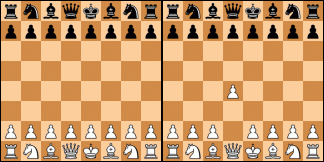
I had seen this problem before, so I know the solution, but I did not know that the problem was that old! Googling the position retrieves a problem of 1623 by Gioachino Greco. It was difficult to find his manuscripts, but I succeeded with one of them, thanks to the title given at Wikipedia article about Greco.

Thank you very much to the Cleveland Public Library Digital Gallery, which hosts a copy of Trattato del Nobilissimo et Militare Essercitio de Scacchi nel Quale si Contengono Molti Bellissimi Tratti et la Vera Scienza di Esso Gioco. Composto da Gioachino Greco Calabrese. I was lucky enough to find the problem without diagrammes and in a foreign language to me (Italian). It starts at the end of this page:

https://cplorg.contentdm.oclc.org/digit ... 20/id/9597

The setup of the white pieces starts at:
Greco wrote:B. Re alla casa di suo C.
B. Ro di suo Re alla 2ª casa di A. di suo Re.
And continues through the next page:
Greco wrote:B. A. di suo Re alla 3ª sua
B. P. di C. di suo Re alla sua casa.
B. P. di Ro. di suo Re alla sua casa.
____________________________________
N. Re alla 4ª casa di suo C.
N. A. di sua D. alla 4ª casa di A. di suo Re.
N. Ro. di sua D. alla sua casa.
'Black will draw against white':
Greco wrote:Il nero farà patta al bianco.
After the first moves, the key move ..., Bh3 is written as it follows:
Greco wrote:N. A. di sua D. alla 3ª casa di Ro. di Re con.
Then: gxh3 (PxB), black king goes to h8 and draw:
Greco wrote:B. P. di C. di suo Re p. A. con.
N. Re alla casa di suo Ro. et farà patta al bianco.
Some typos are expected because I do not know Italian language.

Image

Image

Image

Regards from Spain.

Ajedrecista.
User avatar
Ajedrecista
Posts: 2162
Joined: Wed Jul 13, 2011 9:04 pm
Location: Madrid, Spain.

Re: Digitised historical manuscripts, etc.

Post by Ajedrecista »

Hello:

I have not wanted to spoil the thread, but it has been two months. I hope everything is OK.

The Greco's manuscript quoted is available online, so are old books such as Lucena's (1497), Damiano's (1512), Ruy López's (1561) and Pietro Carrera's (1617), some at Google Books, others at online national libraries.

Escacs d'amor poem original manuscript, nowadays considered a bit older than Lucena's book, is currently lost, but it was photographed before its disappearance and digital reproductions supposedly can be requested through the library that host the copies:

https://explora.bnc.cat/discovery/fulld ... s&offset=0

The authors of Escacs d'amor were tributed in 2020 with a #4 problem —easy for engines— that features a cracking first move and a diagonal full of pieces at some point before the checkmate. Can you solve without engines?

[d]R5nk/2rp2pp/3p1P2/Q1B5/n3B3/6b1/bP6/K5R1 w - - 0 1

Source: https://www.facv.org/2022/2022-acta-nac ... oderno.pdf

Regards from Spain.

Ajedrecista.
User avatar
Ajedrecista
Posts: 2162
Joined: Wed Jul 13, 2011 9:04 pm
Location: Madrid, Spain.

Re: Digitised historical manuscripts, etc.

Post by Ajedrecista »

Hello again:
jp wrote: Tue Aug 02, 2022 12:22 pm I'll first quote a post by Ajedrecista and continue discussion in later posts.

(Thanks, Ajedrecista. That is very interesting!)

[...]
I forgot to quote the OP.

I also forgot that there is other work between Escacs d'amor and Lucena's book. It is a book by Francesc Vicent around 1495 called Libre dels jochs partits dels schacs en nombre de 100 (spelling may vary slightly across different sources). It is other lost work, without photographs in this case (but some copies might have survived, source here), so the image attached to Vicent's book in this interesting Twitter thread does not correspond with Vicent's book. That image seems extracted from a facsimile of an even older book about games —not only chess—, the famous Libro de los juegos (1283) by King Alfonso X of Castile, also known as Libro del axedrez, dados e tablas. I was not aware of an online version until today, when I happily reached this web:

https://rbdigital.realbiblioteca.es/s/rbme/item/13125

In fact, the image shown at that Twitter thread corresponds to folios 0041V and 0042R of Libro de los juegos, following the notation of the viewer.

All in all, my short research has found online availability of books of 1283, 1497, 1512, 1561, 1617 and around 1620s (Greco's undated manuscript); while I mention two works from circa 1470s (Castelvi's et al) and 1495 (Vicent's).

The web Valencia, origin of chess is a must read. This site was launched to promote Kasparov — Karpov match of 2009 in the context of spread a more less accepted claim of a change of chess rules, specially giving more power to the queen, probably set in Spain at the end of the 15th century.

There are other manuscripts: Cesena and Perugia manuscripts:

https://www.origenvalencianodelajedrez. ... .php?pk=25

Where some of the problems are based on Vicent's book according to this excellent site.

Regards from Spain.

Ajedrecista.
Krzysztof Grzelak
Posts: 1586
Joined: Tue Jul 15, 2014 12:47 pm

Re: Digitised historical manuscripts, etc.

Post by Krzysztof Grzelak »

I am still looking for information about the book Göttingen manuscript.
User avatar
Ajedrecista
Posts: 2162
Joined: Wed Jul 13, 2011 9:04 pm
Location: Madrid, Spain.

Re: Digitised historical manuscripts, etc.

Post by Ajedrecista »

Hello Krzysztof:
Krzysztof Grzelak wrote: Mon Oct 03, 2022 8:34 pm I am still looking for information about the book Göttingen manuscript.
I know, I still remember your query from 2014:

Göttingen manuscript

I have not searched for this exact manuscript since then, but the information that I got should hold: the thirty problems in the same order when comparing Lucena's book and Göttingen manuscript. If I am lucky like today with Libro de los juegos, you can be sure that I will share my findings.

Regards from Spain.

Ajedrecista.
Krzysztof Grzelak
Posts: 1586
Joined: Tue Jul 15, 2014 12:47 pm

Re: Digitised historical manuscripts, etc.

Post by Krzysztof Grzelak »

I know - thanks for the information.
User avatar
Ajedrecista
Posts: 2162
Joined: Wed Jul 13, 2011 9:04 pm
Location: Madrid, Spain.

Re: Digitised historical manuscripts, etc.

Post by Ajedrecista »

Hello:

I do not bring links to manuscripts this time, but I was close:

· Bonus Socius manuscript (ca. 1300): I found a book printed in 1910 that contains photographs of some old manuscripts such as Bonius Socius, Lucena's book, Damiano's book (edition of year 1594), Paris MS, manuscripts by Jacobus de Cessolis, William Caxton's book (2nd Ed., 1480)... along with explanations. A must read.

Page by page version.
PDF version (9.3 MB).

I also found some pages of what 'The Morgan Library & Museum' lists as Bonius Socius:

http://ica.themorgan.org/manuscript/page/1/77047

Which looks different to Bonius Socius screenshots that I find on the Internet. It can be a later copy of the manuscript according to this web:

https://sites.google.com/site/carolusch ... u-d-echecs

With some links to the Bibliothèque Nationale de France (the National Library of France).

------------------------

· De ludo scachorum manuscript (ca. 1479): there is a digital copy at the University of Salamanca. However, I can not access to the version right now (supposedly a PDF of 48.62 MB). I copy the links here just in case we are lucky in future requests:

https://web.archive.org/web/20210917083 ... 366/115678
https://web.archive.org/web/20210917083 ... sAllowed=y

Regards from Spain.

Ajedrecista.
User avatar
Ajedrecista
Posts: 2162
Joined: Wed Jul 13, 2011 9:04 pm
Location: Madrid, Spain.

Re: Digitised historical manuscripts, etc.

Post by Ajedrecista »

Hello:
Ajedrecista wrote: Sun Oct 30, 2022 2:33 pm[...]

· De ludo scachorum manuscript (ca. 1479): there is a digital copy at the University of Salamanca. However, I can not access to the version right now (supposedly a PDF of 48.62 MB). I copy the links here just in case we are lucky in future requests:

https://web.archive.org/web/20210917083 ... 366/115678
https://web.archive.org/web/20210917083 ... sAllowed=y

[...]
These two links work for me today, so I copy them without The WayBack Machine trick:

https://gredos.usal.es/handle/10366/115678
https://gredos.usal.es/bitstream/handle ... sAllowed=y

The PDF contains 51 pages without diagrammes (47 of them with two-column text written in Latin). The document is dated on 23rd August, 1479. With the help of Google Translator and given the fact that I do not know Latin plus the Gothic font —which adds difficulty to me—, it looks like this text deals with more things than chess.

I would say that chess stuff starts in a new chapter in the right column of page 39 of the PDF, probably speaking about the origins of chess, something similar to Ruy López's book. The next chapter (right column of page 40 of the PDF) explains how kings move according to its title; so does the next chapter with the queens (start of the page 42 of the PDF). Bishops moves are explained before rooks moves, much in the fashion of Ruy López's book (writing from memory), surely because the author starts from the centre of the board, then goes to the sides.

My description does not correspond with the Wikipedia article (written by Luca Pacioli and with over a hundred problems). This item from the University of Salamanca has a handwritten annotation in red colour at the top of the first page, which says Cessolis, in reference to Jacobus de Cessolis. The Wikipedia article about Cessolis contains valuable external links to very old chess books hosted by different libraries, surely different versions of the few early works about chess.

Regards from Spain.

Ajedrecista.
User avatar
Ajedrecista
Posts: 2162
Joined: Wed Jul 13, 2011 9:04 pm
Location: Madrid, Spain.

Re: Digitised historical manuscripts, etc.

Post by Ajedrecista »

Hello:

The Cleveland Public Library Digital Library hosts a copy of Questo libro é di Giulio Polerio Lancianese al Suo Comando, e deli Amici à Presso, an undated manuscript by Giulio Cesare Polerio:

https://cplorg.contentdm.oclc.org/digit ... ifest.json

The games are anotated in old, long descriptive notaton in Italian, thus being difficult for me to translate. For example, decoding the moves of the first game of the book at page 18:

Image
Way of playing chess, who ordered the game: Giulio Cesare.

1.- e4, e5
2.- Nf3, Nc6
3.- Bc4, Bc5
4.- c3, Nf6
5.- Ng5, O-O
6.- d4, h6
7.- h4, hxg5
8.- hxg5
Mate soon.
Fifteen plies in one page. Curious word for the castling (saltará, 'will jump'). Move typos are expected since Italian is not my born language, plus the amount of abbreviations and handwritten italics.

'Laus Deo' header in Latin ('Praise God'). This practice was very common back then in many books on different topics.

Other curiosity is a sentence written in French at the top of this page, added long after Polerio's work: Cette feuille est de plus que dans l'original ('This sheet is longer than in the original'). In a similar fashion, Fac - Simile ('Facsimile') can be read at the bottom of the page.

Regards from Spain.

Ajedrecista.
User avatar
Ajedrecista
Posts: 2162
Joined: Wed Jul 13, 2011 9:04 pm
Location: Madrid, Spain.

Re: Digitised historical manuscripts, etc.

Post by Ajedrecista »

Hello:

I found other manuscript just by chance, this time the last mention of this list:

https://www.centro-studi-triplice-cinta ... pts-codex/
Miscellanea Cerney Abbey. Biblioteca del Trinity College, Manoscritto 1149 (ex 0.2.45), datazione circa 1250/1300 (dopo il 1248). Al f. 2v vi sono una TC (Nine- Men's-Morris), un Alquerque, un gioco nordico del daldøsa. Nella pagina accanto due belle scacchiere
This is, a manuscript probably from the second half of the 13th century from Cerne Abbey, in Dorset (UK). The URL of the list pointing to the manuscript is no longer valid; however, I found the current link:

https://mss-cat.trin.cam.ac.uk/Manuscript/O.2.45

Thank you very much to The James Catalogue of Western Manuscripts of the section of manuscripts of the Trinity College Library.

Code: Select all

Miscellaneous, Cerne Abbey
Shelfmark: O.2.45
James Number: 1149
The viewer of the manuscript is in the following link:

https://mss-cat.trin.cam.ac.uk/Manuscript/O.2.45/UV

This manuscript is not about chess fully, but there are at least two chessboards at page 3:

https://mss-cat.trin.cam.ac.uk/Manuscri ... 844%2C1343

Image

Big image of the pages 2 and 3 here:

https://mss-cat.trin.cam.ac.uk:8183/iii ... efault.jpg

I post the full size image as a link and not as an image because it might be too big to fit in the thread, specially on mobile devices.

The contents description of the manuscript says:
Contents wrote:[...]
The contents of the portion of the volume before us are:
[...]
4. p.3 Two careful drawings of chess-boards coloured, the one green and white, the other blue and yellow
Above are the lines
Quando duos tenet ultima linea reges
Quem sequitur fugiens astanti sit color idem.
Under and about the drawings has been a good deal of writing in red, which has almost entirely disappeared.
The rest of the page contains verses, first about chess.
It pedes ad bellum prior incipit ipse duellum
(14 lines. Hagen Carmina medii aevi, p.141).
Then miscellaneous lines with effaced rubrics, e.g.
Ar cupit esse tifex ander de pluribus alex.
[...]
Approximated translations of the lines above the chessboards from Google Translator:
  • Quando duos tenet ultima linea reges → When the last line holds two kings.
  • Quem sequitur fugiens astanti sit color idem. → That which is followed by the fleeing bystander should be the same color.
I can not identify the pieces, but we can see 'light on right' since the early days.

The poem below the chessboards can be easily found on the Internet, just searching the first line 'It pedes ad bellum prior incipit ipse duellum', which describes the moves of the pieces at that time.

Regards from Spain.

Ajedrecista.