Hello:
I want to add something inside all this technical discussion:
Op1 - Partial 8-piece tablebase available
This is an article on Lichess blog posted today about the generation, storage and uploading of op1 partial 8-man EGTB.
Regards from Spain.
Ajedrecista.
Tablebase suggestion
Moderator: Ras
-
Ajedrecista
- Posts: 2255
- Joined: Wed Jul 13, 2011 9:04 pm
- Location: Madrid, Spain.
-
Jouni
- Posts: 3907
- Joined: Wed Mar 08, 2006 8:15 pm
- Full name: Jouni Uski
Re: Tablebase suggestion
What is 7/8 piece benefit? Remainder:
TB6 on SSD
Results of Stockfish vs StockfishSyzygy (10+0.1, 1t, 16MB, UHO_XXL_+0.90_+1.19.pgn):
Elo: -1.26 +/- 1.46, nElo: -2.64 +/- 3.05
LOS: 4.46 %, DrawRatio: 57.40 %, PairsRatio: 0.96
Games: 50000, Wins: 13671, Losses: 13853, Draws: 22476, Points: 24909.0 (49.82 %)
Ptnml(0-2): [130, 5293, 14349, 5085, 143], WL/DD Ratio: 1.37
TB6 on SSD
Results of Stockfish vs StockfishSyzygy (10+0.1, 1t, 16MB, UHO_XXL_+0.90_+1.19.pgn):
Elo: -1.26 +/- 1.46, nElo: -2.64 +/- 3.05
LOS: 4.46 %, DrawRatio: 57.40 %, PairsRatio: 0.96
Games: 50000, Wins: 13671, Losses: 13853, Draws: 22476, Points: 24909.0 (49.82 %)
Ptnml(0-2): [130, 5293, 14349, 5085, 143], WL/DD Ratio: 1.37
Jouni
-
syzygy
- Posts: 6046
- Joined: Tue Feb 28, 2012 11:56 pm
Re: Tablebase suggestion.
Interesting. So 9-piece op2 is indeed being worked on.Ajedrecista wrote: ↑Sat Feb 07, 2026 6:47 pm Hello:
I want to add something inside all this technical discussion:
Op1 - Partial 8-piece tablebase available
This is an article on Lichess blog posted today about the generation, storage and uploading of op1 partial 8-man EGTB.
-
Geezer one
- Posts: 18
- Joined: Wed Jul 24, 2024 4:40 pm
- Full name: Guy Russo
Re: Tablebase suggestion
Engine strength is highly dependant on Neural Nets. They were trained with tablebase data included. 8 piece tablebase could improve that training data.Jouni wrote: ↑Sat Feb 07, 2026 7:39 pm What is 7/8 piece benefit? Remainder:
TB6 on SSD
Results of Stockfish vs StockfishSyzygy (10+0.1, 1t, 16MB, UHO_XXL_+0.90_+1.19.pgn):
Elo: -1.26 +/- 1.46, nElo: -2.64 +/- 3.05
LOS: 4.46 %, DrawRatio: 57.40 %, PairsRatio: 0.96
Games: 50000, Wins: 13671, Losses: 13853, Draws: 22476, Points: 24909.0 (49.82 %)
Ptnml(0-2): [130, 5293, 14349, 5085, 143], WL/DD Ratio: 1.37
-
syzygy
- Posts: 6046
- Joined: Tue Feb 28, 2012 11:56 pm
Re: Tablebase suggestion
Instead of working with intermediate "W" and "B" tables to and from which WIN/LOSE_IN_N(n) positions are added and extracted during each iteration, it seems a lot more efficient to keep everything in bitmaps and only merge them at the end. This probably requires more disk space for intermediate files, but if disk space is limited then generating 8-piece tables is a very silly idea to begin with.syzygy wrote: ↑Thu Feb 05, 2026 11:40 pmThe first half of the iteration is:(and then we do the same steps with W and B reversed)Code: Select all
S1 = Load(W, WIN_IN_N(n));
R1 = Predecessor(S1);
S2 = Load(B, UNKNOWN);
S2 = S2 & R1;
----
R2 = Load(W, WIN_IN<=N(n));
S3 = ProveSuccessor(S2, R2);
B = Add(S3, LOSE_IN_N(n));
----
R3 = Predecessor(S3);
S4 = Load(W, UNKNOWN);
S4 = S4 & R3;
W = Add(S4, WIN_IN_N(n+1));
So the goal is to generate the WIN_IN_N(n) and LOSE_IN_N(n) bitmaps for both wtm and btm.
To do this, the algorithm also needs to maintain UNKNOWN and WIN_IN<=N(n) bitmaps (for both wtm and btm).
However, what is the UNKNOWN bitmap used for exactly:
Code: Select all
S1 = Load(W, WIN_IN_N(n));
R1 = Predecessor(S1);
S2 = Load(B, UNKNOWN);
S2 = S2 & R1;
----
R2 = Load(W, WIN_IN<=N(n));
S3 = ProveSuccessor(S2, R2);
B = Add(S3, LOSE_IN_N(n));So we already know that R1 will not contain any LOSE_IN_N(k) positions for k < N.
So the AND operation with UNKNOWN can only remove illegal positions and positions which have been determined to be a win.
The set of positions that have been determined to be a win corresponds to the WIN_IN<=N(n) bitmap.
What if we include in the WIN_IN_<=N(n) bitmap the set of ILLEGAL positions. Then we don't need the UNKNOWN bitmap to generate LOSE_IN_N(n).
(So instead of AND with UNKNOWN, we AND with NOT WIN_IN_<=N(n).)
Now what about these two lines:
Code: Select all
R2 = Load(W, WIN_IN<=N(n));
S3 = ProveSuccessor(S2, R2);The other part is:
Code: Select all
R3 = Predecessor(S3);
S4 = Load(W, UNKNOWN);
S4 = S4 & R3;
W = Add(S4, WIN_IN_N(n+1));So, again, the AND operation with UNKNOWN can only remove illegal positions and positions which have been determined earlier to be a win.
So we can again replace UNKNOWN with the bitmap that is the union of ILLEGAL and WIN_IN<=N(n).
So maintaining an UNKNOWN bitmap does not seem necessary. We only need to maintain wtm and btm bitmaps of illegal plus winning positions. This is a very welcome simplification and efficiency gain.
-
Ajedrecista
- Posts: 2255
- Joined: Wed Jul 13, 2011 9:04 pm
- Location: Madrid, Spain.
Re: Tablebase suggestion.
Hello:
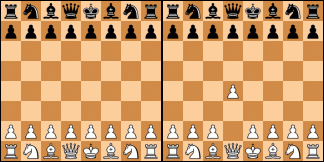
I played another interesting-to-me game today: I played four 5+0 games against a much better player than me and lost the first three clearly, although not in few moves. I was white in the fourth, an Albin Countergambit arose and there were many trades until we reached a B+4P vs. B+4P endgame (both LSB) with an unpleasant position for me with less time on the clock, but not in time trouble. The key position was:
[d]8/p7/2b5/P1p5/2P4p/5k2/3K3P/5B2 w - - 1 42
I rightly thought that my bishop should stay at f1-h3 diagonal (g3 square covered by Ph2 and g2 square covered by Bf1), but I played Ke1? instead the only drawing move Bh3!
There were 4,480,179 TB hits to the full set of 3, 4 and 5-man Syzygy EGTB, but please take a look into the little scare at depths 93 and 94 with almost one million TB hits, where SF 18 doubted about drawing or not. Since the position is a 10-man Op3 following the notation of the thread and some lines include ..., Kxh2, this would lead to a 9-man Op2, which would be very valuable here.
Placing your bishop in front of your own pawn to get some barrier on the g-file looks risky in my position because my pawn could be taken. It would have been a draw anyway, but very difficult to me... I did not even consider Bh3 to be fair.
Here is a PGN with some proposed lines:
[pgn][Event ""]
[Site ""]
[Round ""]
[Date "2026.02.13"]
[SetUp "1"]
[FEN "8/p7/2b5/P1p5/2P4p/5k2/3K3P/5B2 w - - 1 42"]
[Result "1/2-1/2"]
42.Bh3! (42.Ke1? Ke3 1-0 {(The true moves of the game)}) 42...Kf2 43.Be6 Kg1 44.Ke3 Kxh2 45.Kf2 {(The cage)} 45...h3 46.Bd5 Bd7 (46...Bxd5 47.cxd5 c4 1/2-1/2) 47.Be4 (47.Bf7 Kh1 48.Bd5+ (48.Bg8 Bc6 49.Be6 Kh2 (49...h2? 50.Bd5+ Bxd5 51.cxd5 c4 52.d6 c3 53.d7 c2 54.d8=Q c1=Q 55.Qd5# 1-0) 1/2-1/2) 48...Kh2 49.Bf7 1/2-1/2) 47...Be6 48.Bd5 1/2-1/2[/pgn]
Including my trademark cage of the cornered king which has become recurrent for me for some time now. If black dares to play ..., h2 after ..., Kh1, then faces the permanent threat of a checkmate with the bishop through the a8-h1 diagonal.
------------
Bh3! looks counterintuitive for a patzer like me, but I remember to have seen something similar before:
The power of a bishop facing three connected passed pawns.
67.- ..., Bh3! to win, with the same idea of build a barrier on the g-file.
Regards from Spain.
Ajedrecista.
I played another interesting-to-me game today: I played four 5+0 games against a much better player than me and lost the first three clearly, although not in few moves. I was white in the fourth, an Albin Countergambit arose and there were many trades until we reached a B+4P vs. B+4P endgame (both LSB) with an unpleasant position for me with less time on the clock, but not in time trouble. The key position was:
[d]8/p7/2b5/P1p5/2P4p/5k2/3K3P/5B2 w - - 1 42
I rightly thought that my bishop should stay at f1-h3 diagonal (g3 square covered by Ph2 and g2 square covered by Bf1), but I played Ke1? instead the only drawing move Bh3!
Code: Select all
FEN: 8/p7/2b5/P1p5/2P4p/5k2/3K3P/5B2 w - - 1 42

Stockfish-18-windows-x86-64-sse41-popcnt:
Found 145 WDL and 145 DTZ tablebase files (up to 5-man).
Available processors: 0-3
Using 2 threads
NNUE evaluation using nn-c288c895ea92.nnue (125MiB, (102384, 1024, 15, 32, 1))
NNUE evaluation using nn-37f18f62d772.nnue (6MiB, (22528, 128, 15, 32, 1))
Network replica 1: Shared memory.
[...]
 91/24	00:22	  17.313.508	788.267	 0,00	Bf1h3 Bc6e8 Bh3e6 Kf3e4 Kd2c3 Ke4e3 Be6g8 Be8g6 Bg8e6
 92/48	00:28	  22.049.519	791.582	 0,00	Bf1h3 Bc6e8 Bh3e6 Kf3e4 Kd2c3 Ke4e3 Be6d5 Be8d7 Bd5g8 Bd7g4 Bg8f7 Bg4d1 Bf7d5 Ke3f2 Kc3d3 Kf2g1 Kd3e3 Kg1xh2 Ke3f2 Kh2h3 Bd5e6+ Bd1g4 Be6d5 Bg4c8 Kf2f3 Kh3h2 Kf3f2
 93/36-	00:49	  37.285.246	762.729	-0,02	Bf1h3 Bc6e8
 93/46-	00:53	  42.333.244	789.799	-0,03	Bf1h3 Bc6e8
 93/61-	01:44	 111.481.494	1.068.721	-0,30	Bf1h3 Bc6e8
 93/131+	02:30	 177.231.504	1.180.850	-0,30	Bf1h3
 93/131+	03:27	 293.690.190	1.414.999	-0,17	Bf1h3
 93/131	05:30	 570.830.976	1.729.224	-0,14	Bf1h3 Bc6e8 Bh3e6 Kf3e4 Kd2c3 Ke4e3 Be6d5 Be8g6 Bd5e6 Ke3e2 Be6d5 Ke2d1 Bd5e6 Kd1e1 Be6d5 Bg6h7 Bd5e6 Ke1d1 Be6f7 Bh7e4 Bf7h5+ Kd1e1 Bh5f7 Be4f5 Bf7d5 Ke1d1 Bd5f3+ Kd1c1 Bf3h5 Kc1b1 Bh5e8 Kb1a2 Be8a4 Bf5g6 Ba4c6 Bg6h5 Bc6a4 Ka2a3 Ba4c6 Bh5d1 Bc6d7 Bd1f3 Bd7e8 Bf3e4 Be8b5 Be4h7 Bb5e8 Ka3a2 Be8c6 Ka2b1 Bc6d7 Bh7e4 Kc3b3 Be4c2+ Kb3c3 Kb1c1 Bd7c8 Bc2a4 Kc3d3 Ba4b3 Kd3c3 Bb3c2 Bc8e6 Bc2h7 Be6d7 Bh7g6 Bd7g4 Bg6e4 Bg4e6 Kc1b1 Kc3d2 Be4g2 Kd2e3 Kb1c2 Ke3f4 Bg2f1 Kf4g4 h4h3 Kg4g3 Kc2c3 Be6xh3 Bf1xc4 Bh3f5 Kc3b4 h2h4 Kb4xa5 h4h5 Ka5b4 Kg3f4
 94/28+	05:30	 571.259.879	1.729.502	-0,17	Bf1h3
 94/28+	05:39	 588.486.914	1.734.205	-0,15	Bf1h3
 94/44+	07:03	 773.477.014	1.828.697	-0,02	Bf1h3
 94/44	07:09	 785.372.905	1.830.855	 0,00	Bf1h3 Bc6e8 Bh3e6 Kf3e4 Kd2c3 Ke4e3 Be6g8 Be8g6 Bg8d5 Bg6f5 Bd5f7 Ke3e2 Bf7g8 Bf5g6 Bg8d5 Bg6f5
 95/19+	07:09	 785.841.166	1.830.944	-0,01	Bf1h3
 95/29	07:12	 789.708.706	1.828.905	 0,00	Bf1h3 Bc6e8 Bh3e6 Kf3e4 Kd2c3 Be8g6 Be6d5+ Ke4e3 Bd5g8 Bg6e8 Bg8e6 Be8h5 Be6d5 Ke3f2 Kc3d2 Kf2g1 Kd2e1 Bh5g4 Bd5f7 Kg1xh2 Ke1f2 Bg4d7 Bf7g8 Kh2h3 Kf2f3 Bd7g4+ Kf3f2 Bg4d7
 96/34	07:13	 792.052.654	1.827.701	 0,00	Bf1h3 Bc6e8 Bh3e6 Kf3e4 Kd2c3 Be8g6 Be6d5+ Ke4e3 Bd5e6 Bg6h5 Be6g8 Ke3e2 Bg8d5 Bh5g4 Bd5f7 Ke2e3 Bf7g8 Bg4f5 Bg8d5
 97/63	07:25	 807.839.647	1.812.746	 0,00	Bf1h3 Bc6e8 Bh3e6 Kf3e4 Kd2c3 Ke4e3 Be6g8 Be8d7 Bg8d5 Bd7f5 Bd5f7 Bf5d3 Bf7g8 Bd3f1 Bg8e6 Ke3e2 Be6g8 Ke2f2 Kc3d2 Kf2g2 Kd2e3 Kg2xh2 Ke3f2 Bf1h3 Bg8f7 Bh3d7 Bf7d5 Bd7g4 Bd5g8 Bg4h5 Bg8e6 Bh5d1 Be6g8 Kh2h3 Bg8e6+ Bd1g4 Be6f7 Bg4f5 Kf2f3 Bf5c2 Bf7e6+ Kh3h2 Kf3f2 Bc2b3 Be6g8 Bb3a4 Bg8e6 Ba4c2 Be6f7 Bc2e4 Bf7e6 Be4c2
 98/13	07:26	 808.349.428	1.811.390	 0,00	Bf1h3 Bc6e8 Bh3e6 Kf3e4 Kd2c3 Ke4e3 Be6g8 Be8g6 Bg8e6 Bg6h5 Be6d5 Bh5e8
[...]
 128/36	13:00	1.143.422.244	1.465.538	 0,00	Bf1h3 Bc6e8 Bh3e6 Kf3e4 Kd2c3 Be8g6 Be6d5+ Ke4e3 Bd5g8 Ke3e2 Bg8d5
 129/30	13:45	1.216.096.789	1.473.799	 0,00	Bf1h3 Bc6e8 Bh3e6 Kf3e4 Kd2c3 Be8g6 Be6d5+ Ke4e3 Bd5g8 Ke3e2 Bg8d5 Ke2f2 Kc3d2 Bg6h5 Bd5e6 Kf2g2 Kd2e3 Kg2xh2 Ke3f2 Bh5d1 Be6g8 Kh2h3 Bg8e6+
130/32 14:00 1.233.869.676 1.467.706 0,00 Bf1h3 Bc6e8 Bh3e6 Kf3e4 Kd2c3 Be8g6 Be6d5+ Ke4e3 Bd5g8 Ke3e2 Bg8d5------------
Placing your bishop in front of your own pawn to get some barrier on the g-file looks risky in my position because my pawn could be taken. It would have been a draw anyway, but very difficult to me... I did not even consider Bh3 to be fair.
Here is a PGN with some proposed lines:
[pgn][Event ""]
[Site ""]
[Round ""]
[Date "2026.02.13"]
[SetUp "1"]
[FEN "8/p7/2b5/P1p5/2P4p/5k2/3K3P/5B2 w - - 1 42"]
[Result "1/2-1/2"]
42.Bh3! (42.Ke1? Ke3 1-0 {(The true moves of the game)}) 42...Kf2 43.Be6 Kg1 44.Ke3 Kxh2 45.Kf2 {(The cage)} 45...h3 46.Bd5 Bd7 (46...Bxd5 47.cxd5 c4 1/2-1/2) 47.Be4 (47.Bf7 Kh1 48.Bd5+ (48.Bg8 Bc6 49.Be6 Kh2 (49...h2? 50.Bd5+ Bxd5 51.cxd5 c4 52.d6 c3 53.d7 c2 54.d8=Q c1=Q 55.Qd5# 1-0) 1/2-1/2) 48...Kh2 49.Bf7 1/2-1/2) 47...Be6 48.Bd5 1/2-1/2[/pgn]
Including my trademark cage of the cornered king which has become recurrent for me for some time now. If black dares to play ..., h2 after ..., Kh1, then faces the permanent threat of a checkmate with the bishop through the a8-h1 diagonal.
------------
Bh3! looks counterintuitive for a patzer like me, but I remember to have seen something similar before:
The power of a bishop facing three connected passed pawns.
67.- ..., Bh3! to win, with the same idea of build a barrier on the g-file.
Regards from Spain.
Ajedrecista.
-
syzygy
- Posts: 6046
- Joined: Tue Feb 28, 2012 11:56 pm
Re: Tablebase suggestion
I now have a very basic working implementation. I'm using one extra K-slice in RAM, so 20 in total, to simplify the implementation a bit (basically the generator now streams bitmaps from/to disk a K-slice at a time, where in principle this could be done in smaller blocks).syzygy wrote: ↑Wed Feb 04, 2026 9:44 pmI am reasonably sure that 19 K-slices as I described is optimal.
But it is still possible that the whole thing does not work because I overlooked something (or am hallucinating).
If it works, then the largest 8-piece pawnless tables can apparently be generated with somewhat reasonable efficiency on a "low-end" system with 128 GB of RAM. It would be good to have ECC memory, though.
Still a lot of work to be done to make it usable, but at least the approach is sound.
It does create many tens of thousands of intermediate files on disk, though. For the largest 8-piece table, each file is 5.15GB of data before compression.
When the whole table has been calculated, the bitmaps for different plies can be merged K-slice by K-slice in RAM (even with 2 bytes per position, this only requires the equivalent of 16 K-slices of RAM, or 17 K-slices when using the same simplification as mentioned above).
Merging could also be done more often, for example every 10 plies, to reduce disk space usage.
-
syzygy
- Posts: 6046
- Joined: Tue Feb 28, 2012 11:56 pm
Re: Tablebase suggestion
I have now added the 50-move rule, compression and multithreading.syzygy wrote: ↑Sat Feb 14, 2026 10:26 pmI now have a very basic working implementation. I'm using one extra K-slice in RAM, so 20 in total, to simplify the implementation a bit (basically the generator now streams bitmaps from/to disk a K-slice at a time, where in principle this could be done in smaller blocks).
Still a lot of work to be done to make it usable, but at least the approach is sound.
It does create many tens of thousands of intermediate files on disk, though. For the largest 8-piece table, each file is 5.15GB of data before compression.
The statistics are identical to those produced by my in-RAM generator, so all the logic seems to be correct.
For KQRvKQR, it ends up with about 5.5 GB of data on disk (spread over 243,015 files), which isn't bad given that the uncompressed tablebase with 1 byte per position would take up 11.5 GB (if we ignore the white<->black symmetry). A 20 TB hard drive should be about big enough to generate a worst case pawnless 8-men table. (But where to store them after generation...)
I did not yet measure the total amount of data being read and written. That would be an interesting statistic.
Most files are very small. Unfortunately, the files that need to be read and written multiple times during each iteration are relatively large. Perhaps something can be gained here by being clever.
Generation on my PC took 15m9s using 16 cores/32 threads and with the files being saved on RAM disk. Multithreading should be more effective with 7-piece and 8-piece tables because the work units will be much bigger (one K-slice of KQRvKQR is just 1.6MB). But the amount of sequential disk I/O will be very substantial...
-
Dann Corbit
- Posts: 12870
- Joined: Wed Mar 08, 2006 8:57 pm
- Location: Redmond, WA USA
Re: Tablebase suggestion
I was able to build the syzygy 7 man tool kit.
Then, I took a look at the system requirements.
At 128GB RAM, I thought I might be able to help the project.
Turns out, I am only 10% of the way to a minimal setup.
Can't put any more RAM on my motherboard, so I guess an EPYC system would be required.
Considering the current cost of RAM, I think helping out is right out for the time being.
Then, I took a look at the system requirements.
At 128GB RAM, I thought I might be able to help the project.
Turns out, I am only 10% of the way to a minimal setup.
Can't put any more RAM on my motherboard, so I guess an EPYC system would be required.
Considering the current cost of RAM, I think helping out is right out for the time being.
Taking ideas is not a vice, it is a virtue. We have another word for this. It is called learning.
But sharing ideas is an even greater virtue. We have another word for this. It is called teaching.
But sharing ideas is an even greater virtue. We have another word for this. It is called teaching.
-
syzygy
- Posts: 6046
- Joined: Tue Feb 28, 2012 11:56 pm
Re: Tablebase suggestion
The complete 7-piece set has already been built in 2018 (thanks to Bojun Guo who could ran the generator on systems with 1.5 TB RAM).Dann Corbit wrote: ↑Thu Feb 19, 2026 8:07 am I was able to build the syzygy 7 man tool kit.
Then, I took a look at the system requirements.
At 128GB RAM, I thought I might be able to help the project.
Turns out, I am only 10% of the way to a minimal setup.
Can't put any more RAM on my motherboard, so I guess an EPYC system would be required.
Considering the current cost of RAM, I think helping out is right out for the time being.
But I now have the beginning of a generator than can build 8-piece tablebases on a machine with just 128 GB of RAM (and 64 GB should suffice for most tables).
However, generation will be disk-based and take a very long time for each table. And the generated tables will be way too big to handle.
So in practical terms the generator will be usable for generating 7-men tables on low-end hardware. But simply downloading them will be much faster.