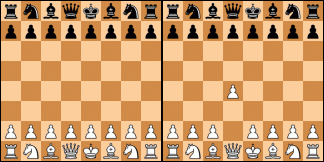
I played other interesting-to-me 5+0 blitz game today, which I finally lost on time in a blunderfest because the positions were double-edged:
[pgn][Event ""]
[Site ""]
[Date "2026.05.28"]
[Round ""]
[TimeControl "300+0"]
[Result "1-0"]
1. e4 c6 2. Nf3 d5 3. exd5 cxd5 4. Nc3 Nf6 5. d3 e6 6. Bg5 Be7 7. d4 O-O 8. Ne5 Nfd7 9. Bxe7 Qxe7 10. Nxd7 Nxd7 11. Be2 Nf6 12. O-O Bd7 13. f4 Rac8 14. Re1 Qd6 15. g3 a6 16. Bf3 Rc7 17. Qd3 Rfc8 18. Rad1 Qc6 19. a3 Qc4 20. Qxc4 Rxc4 21. Be2 R4c7 22. Bf3 Rxc3 23. bxc3 Rxc3 24. Bg2 Rxc2 25. Rc1 Rxc1 26. Rxc1 Bc6 27. h3 Kf8 28. Kf2 Ke7 29. Ke3 Kd6 30. Rb1 Nd7 31. g4 Kc7 32. f5 Nb6 33. fxe6 fxe6 34. Rf1 Nc4+ 35. Kd3 Nxa3 36. Rf7+ Kd6 37. Rxg7 Nc4 38. Rxh7 a5 39. Rh8 a4 40. g5 a3 41. Kc3 Ne3 42. Bh1 b5 43. g6 Nf5 44. h4 b4+ 45. Kb3 Nxd4+ 46. Ka2 Nf5 47. h5 1-0[/pgn]
I was playing a normal game until 22.- Bf3. Then, I took a long thought of almost a minute just to play 22.- ..., Rxc3 (knight and two pawns for my rook). I thought that R×N was not the best move, but I wanted to make the game 'spicy' and try to get ideas for my amateur, low-tier compositions... which luckily happened! Things looked complicated to me after the white rook was capturing pawns on the seventh rank and I aimed for a crazy endgame of two passers versus two passers. Surprisingly, SF thinks that some positions were even in that unbalanced mess. Then, I moved something that SF does not like, white returned the favour and so on.
I played the obvious 45.- ..., Nxd4+ in heavy time pressure and missed other amazing drawing resource: 45.- ..., Ba4+ (a false bishop sac). White can not capture it because my passed a-pawn would queen freely because the rook can not avoid it given that the king obstructs the a-file. Not exactly a firework, but worth mentioning.
------------
This manoeuvre gave me something to think and I composed a problem using the same trick:
[d]5B2/8/6kP/4p1P1/8/6b1/2KP3n/3Br3 w - - 0 1
The position has an unclear result, likely a draw, but the intended solution is 1.- Bh5+, Kxh5; 2.- h7 and the pawn will promote. 1.- ..., Kh7?? does not work for black because there is a strange checkmate with two bishop and two pawns: 2.- Bf7 with the idea of g6+, Kh8; Bg7#. There might be room to compose a better problem featuring this sac.
The same position with a white queen on d1 instead of a LSB also admits 1.- Qh5+, but 1.- h7 is better and winning for white: 1.- ..., Kxh7 does not work for black because of 2.- Qh5+, Kg8 and white checkmates short thereafter.
With either B or Q on d1, the placing of the pieces has their reasons:
- The black rook is protected by the black bishop and defends the first rank and e2 square.
- The black knight on h2 controls f3 and g4 squares of the d1-h5 diagonal, but makes ..., Rh1 useless to control the h-file and the potential h8 queening square.
- The black bishop on g3 makes ..., Rg1 useless to control the g-file and the potential g8 queening square.
- The black pawn on e5 does not allow ..., Be5 to stop the queening on h8.
- The white king on c2 and the white pawn on d2 traps the white queen on d1.
- The white king on c2 restricts the white LSB on d1 to the d1-h5 diagonal.
I did not find any problem featuring a similar sac, which does not mean that does not exist: I simply did not find it. A somewhat similar thing that I remember is a famous game that featured an outstanding queen sac, which has been analysed many times at TalkChess (for example here, here and here).
Regards from Spain.
Ajedrecista.