
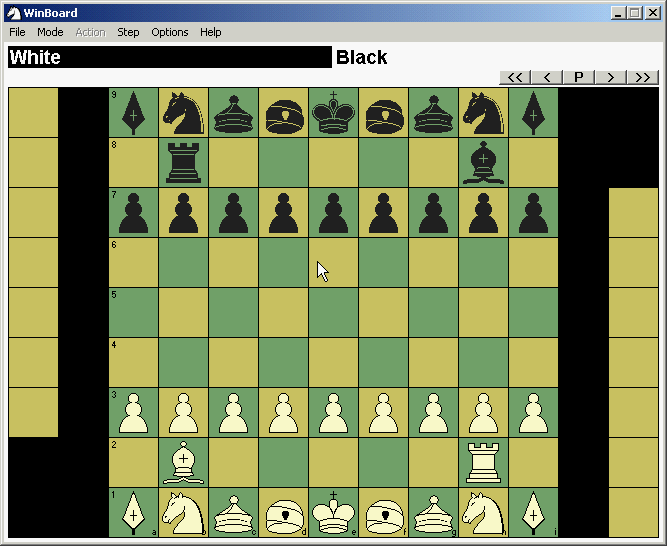
Shogi (Japanese Chess) is a truly fantastic game, if you consider the abstract board game, cleansed from any cultural excesses (such as kanji pieces). The more games I watch, the more I start to appreciate how much better it is than FIDE Chess. Draws are virtually non-existent, and a game is really never decided before checkmate. I have seen pretty strong engines lose from positions that evaluated as +22 (where Rook = 5, as usual).
It is really a pity that we, Chess-engine authors as a group, do not create more Shogi engines. It is a much more challenging task than creating a Chess engine, as for the latter it is pretty much known how exactly you have to do it, and you just follow the recipe. For Shogi, OTOH, there is still very much to discover and invent.
It is perfectly possible to write a Shogi engine without ever having played the game. My own Shogi engine, Shokidoki, is virtually without knowledge, but I had its rating determined by playing it on the 'Floodgate' server. This is a server that continuously plays medium-TC (15min sudden-death) comp-comp games, and calculates a rating based on those that should be comparable to human ratings on 'Shogi Club 24'. The rating corresponded to a good 2-Dan ranking on that server. Not bad at all, for a knowledge-poor 1-CPU program. And I haven't even tuned the piece values.
Millions of people play Shogi, and the yearly computer-Shogi World Championship has many times more participants that any computer-Chess tournament.
As WinBoard supports Shogi, the usual tools are available for developing an engine. You can play fast games, a fair amount of opponent engines are available for setting up a gauntlet (including many strong ones that can be brought into the required rating range by time odds, saving extra CPU time).
So people, please consider Shogi. Otherwise you don't know what you are missing!




 I love the game and still haven't been so ambitious as to try to make an engine ...