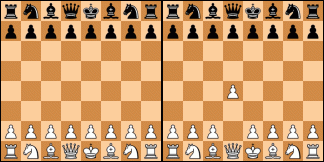
Ajedrecista wrote: ↑Sun Mar 06, 2022 9:02 pm
Hello Mike:
Mike Sherwin wrote: ↑Sun Mar 06, 2022 7:57 pm
When a knight moves it becomes a bishop.
When a bishop moves it becomes a knight.
It would be a piece of cake to implement in a chess engine.
But could a human handle it or would it just be a confusing mess?
Edit: Also queens and rooks can switch but that might just be way to much confusion for a human?
Edit2: I guess I should give it a name before someone else does. I'll call it Jumbled Chess.
I am not a chess variant fan, but just to make sure that I did not misunderstand you:
[d]6rk/6b1/8/7B/8/2N5/4K3/8 w - - 0 1
Then: 1.- Bf7(=Nf7+), Kh7; 2.- Ne4(=Be4#). Right? A similar idea in normal chess would be:
[d]6rk/6b1/8/5KN1/4B3/8/8/8 w - - 0 1
1.- Nf7+, Kh7; 2.- Ke6# (or 2.- Kf4# or 2.- Kg4# or 2.-Kg5#).
Regards from Spain.
Ajedrecista.
Yes Sir, that is exactly correct.
So what is the benefit of playing this variant? Please explain, besides making the game more complicated than what it is already? I believe that it is more interesting to allow a player that is at least 300 rating below another player in a tournament to use Opening book up to 8 moves, and at least one takeback before move 30. That is in tournament where there are players between 1200 thru 2200, but NOT higher than 2200, and everybody higher than 2200 just play normal chess without using Opening Book or taking 1 move back, for instance if in the 1st round a 2200 player is paired with a 1900, then the 1900 could use an Opening book up to move 8, and he can also take any move back before move 30
NOTE: And the same if a 1900 player is playing against a 1600 player but the difference has to be at least 300 rating points.
Ajedrecista wrote: ↑Sun Mar 06, 2022 9:02 pm
Hello Mike:
Mike Sherwin wrote: ↑Sun Mar 06, 2022 7:57 pm
When a knight moves it becomes a bishop.
When a bishop moves it becomes a knight.
It would be a piece of cake to implement in a chess engine.
But could a human handle it or would it just be a confusing mess?
Edit: Also queens and rooks can switch but that might just be way to much confusion for a human?
Edit2: I guess I should give it a name before someone else does. I'll call it Jumbled Chess.
I am not a chess variant fan, but just to make sure that I did not misunderstand you:
[d]6rk/6b1/8/7B/8/2N5/4K3/8 w - - 0 1
Then: 1.- Bf7(=Nf7+), Kh7; 2.- Ne4(=Be4#). Right? A similar idea in normal chess would be:
[d]6rk/6b1/8/5KN1/4B3/8/8/8 w - - 0 1
1.- Nf7+, Kh7; 2.- Ke6# (or 2.- Kf4# or 2.- Kg4# or 2.-Kg5#).
Regards from Spain.
Ajedrecista.
Yes Sir, that is exactly correct.
So what is the benefit of playing this variant? Please explain, besides making the game more complicated than what it is already? I believe that it is more interesting to allow a player that is at least 300 rating below another player in a tournament to use Opening book up to 8 moves, and at least one takeback before move 30. That is in tournament where there are players between 1200 thru 2200, but NOT higher than 2200, and everybody higher than 2200 just play normal chess without using Opening Book or taking 1 move back, for instance if in the 1st round a 2200 player is paired with a 1900, then the 1900 could use an Opening book up to move 8, and he can also take any move back before move 30
NOTE: And the same if a 1900 player is playing against a 1600 player but the difference has to be at least 300 rating points.
Your belief is a personal preference. Each person will have to decide what their preference is.
Examples:
Some people do not like memorizing theory.
Some people might find the extra complication a challenge.
Some people might just like to try something new.
Some people might be excited by the different patterns that they will discover.
Some people might just like forging a path in uncharted waters.
Some people might really like competing mono a mono (see urban dictionary) against someone of their own strength using their own imagination and abilities rather than playing against 300 years of recorded history.
Ajedrecista wrote: ↑Sun Mar 06, 2022 9:02 pm
Hello Mike:
Mike Sherwin wrote: ↑Sun Mar 06, 2022 7:57 pm
When a knight moves it becomes a bishop.
When a bishop moves it becomes a knight.
It would be a piece of cake to implement in a chess engine.
But could a human handle it or would it just be a confusing mess?
Edit: Also queens and rooks can switch but that might just be way to much confusion for a human?
Edit2: I guess I should give it a name before someone else does. I'll call it Jumbled Chess.
I am not a chess variant fan, but just to make sure that I did not misunderstand you:
[d]6rk/6b1/8/7B/8/2N5/4K3/8 w - - 0 1
Then: 1.- Bf7(=Nf7+), Kh7; 2.- Ne4(=Be4#). Right? A similar idea in normal chess would be:
[d]6rk/6b1/8/5KN1/4B3/8/8/8 w - - 0 1
1.- Nf7+, Kh7; 2.- Ke6# (or 2.- Kf4# or 2.- Kg4# or 2.-Kg5#).
Regards from Spain.
Ajedrecista.
Yes Sir, that is exactly correct.
So what is the benefit of playing this variant? Please explain, besides making the game more complicated than what it is already? I believe that it is more interesting to allow a player that is at least 300 rating below another player in a tournament to use Opening book up to 8 moves, and at least one takeback before move 30. That is in tournament where there are players between 1200 thru 2200, but NOT higher than 2200, and everybody higher than 2200 just play normal chess without using Opening Book or taking 1 move back, for instance if in the 1st round a 2200 player is paired with a 1900, then the 1900 could use an Opening book up to move 8, and he can also take any move back before move 30
NOTE: And the same if a 1900 player is playing against a 1600 player but the difference has to be at least 300 rating points.
Your belief is a personal preference. Each person will have to decide what their preference is.
Examples:
Some people do not like memorizing theory.
Some people might find the extra complication a challenge.
Some people might just like to try something new.
Some people might be excited by the different patterns that they will discover.
Some people might just like forging a path in uncharted waters.
Some people might really like competing mono a mono (see urban dictionary) against someone of their own strength using their own imagination and abilities rather than playing against 300 years of recorded history.
IN that case show us positions where this new variant will help us escape with victory instead of defeat or at least with a draw, and if so what is the purpose of working so hard to reach a winning position, if the opponent can get away so easy ?
Ajedrecista wrote: ↑Sun Mar 06, 2022 9:02 pm
Hello Mike:
Mike Sherwin wrote: ↑Sun Mar 06, 2022 7:57 pm
When a knight moves it becomes a bishop.
When a bishop moves it becomes a knight.
It would be a piece of cake to implement in a chess engine.
But could a human handle it or would it just be a confusing mess?
Edit: Also queens and rooks can switch but that might just be way to much confusion for a human?
Edit2: I guess I should give it a name before someone else does. I'll call it Jumbled Chess.
I am not a chess variant fan, but just to make sure that I did not misunderstand you:
[d]6rk/6b1/8/7B/8/2N5/4K3/8 w - - 0 1
Then: 1.- Bf7(=Nf7+), Kh7; 2.- Ne4(=Be4#). Right? A similar idea in normal chess would be:
[d]6rk/6b1/8/5KN1/4B3/8/8/8 w - - 0 1
1.- Nf7+, Kh7; 2.- Ke6# (or 2.- Kf4# or 2.- Kg4# or 2.-Kg5#).
Regards from Spain.
Ajedrecista.
Yes Sir, that is exactly correct.
So what is the benefit of playing this variant? Please explain, besides making the game more complicated than what it is already? I believe that it is more interesting to allow a player that is at least 300 rating below another player in a tournament to use Opening book up to 8 moves, and at least one takeback before move 30. That is in tournament where there are players between 1200 thru 2200, but NOT higher than 2200, and everybody higher than 2200 just play normal chess without using Opening Book or taking 1 move back, for instance if in the 1st round a 2200 player is paired with a 1900, then the 1900 could use an Opening book up to move 8, and he can also take any move back before move 30
NOTE: And the same if a 1900 player is playing against a 1600 player but the difference has to be at least 300 rating points.
Your belief is a personal preference. Each person will have to decide what their preference is.
Examples:
Some people do not like memorizing theory.
Some people might find the extra complication a challenge.
Some people might just like to try something new.
Some people might be excited by the different patterns that they will discover.
Some people might just like forging a path in uncharted waters.
Some people might really like competing mono a mono (see urban dictionary) against someone of their own strength using their own imagination and abilities rather than playing against 300 years of recorded history.
IN that case show us positions where this new variant will help us escape with victory instead of defeat or at least with a draw, and if so what is the purpose of working so hard to reach a winning position, if the opponent can get away so easy ?
Ajedrecista already showed you with his example position. Find somewhere else to feed!
For everyone else the reason I thought of this idea was because while I was working on my new chess engine in MakeMove() I accidentally turned a bishop into knight.
Kyoto Shogi has this alternation of piece types for all non-royal pieces. This is quite hard for humans. In micro-Shogi pieces only toggle type when they capture. Matts Winther once designed a piec (which he called Elk) that would be either Knight or Rook, but depending on the square shade it was on.
Mike Sherwin wrote: ↑Mon Mar 07, 2022 12:50 am
Some people might really like competing mono a mono (see urban dictionary) against someone of their own strength using their own imagination and abilities rather than playing against 300 years of recorded history.
Chess 960 can accomplish this already.
Also, chess is far from done. When I look at current-day high-level games, I'm seeing openings that blow my mind. Some GM's are playing openings that go against basically all the opening principles I've ever learned; in some openings kings are just left in the middle of the board. Attacks routinely start early with a4/h4 and a5/h5 nowadays. Don't move your pieces twice in the opening? Bah. Just let's move them each 5 times, and undevelop a bit here and there as well.
Computers haven't ruined chess and theory IMHO, they are showing us all the things we didn't know, or where our assumptions are wrong. Same as with Go: when AlphaGo first started playing, the top pro's were like: "That's impossible, you can't play like that. It has been proven 200 years ago already!" But AlphaGo _CAN_ play "like that". Just as Stockfish can play moves that are "impossible", because it has seen that super-obscure Ne4-g3-h1 in-between Knight maneuver that no human in his right mind would ever consider, which makes that "impossible" move work, because now "suddenly" f2 is defended at a critical moment.