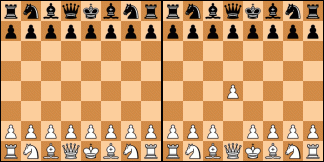
How can this be possible? With some imagination, of course. I composed a position with a mixture of things: a kind of Alekhine's guns for both bishops and queens, the winning side giving checks in every move (I am talking about a #13) and a final checkmate ressembling an Anastasia's mate. The moves annotated with exclamation marks mean that these moves are the only ones to give the shortest checkmate, when there are more possible moves (or the only ones to delay more the checkmate from losing side POV, when there are more possible moves):
[pgn][Event ""]
[Site ""]
[Round ""]
[Date "2026.08.07"]
[SetUp "1"]
[FEN "1B1q3q/B1B2K2/1q1B3r/4Bbk1/qq1qq1pb/B4qPR/nB3PrQ/R7 w - - 0 1"]
[Result "1-0"]
[PlyCount "25"]
1.Bc1+! Nxc1! (1...Kh5? 2.Rxh4! Qxh4 3.Qxh4#! 1-0) 2.Bxc1+! Qde3! 3.Bxe3+! Q6xe3! 4.Bxe3+! Qexe3 5.Bf4+! Qexf4 6.Bxf4+! Qbxf4 7.Bxf4+! Qaxf4 8.Bxf4+! Qxf4! 9.gxf4+! Kh5 10.Rxh4+! Qxh4 11.Qxh4+! Kxh4 12.Rh1+! Rh2 13.Rxh2#! 1-0[/pgn]
All white moves are marked with '!'. SF 18 solves the position in few time, but I was delighted that Chest 5.2 also shines:
Code: Select all
FEN: 1B1q3q/B1B2K2/1q1B3r/4Bbk1/qq1qq1pb/B4qPR/nB3PrQ/R7 w - - 0 1

ChestUCI:
FEN: 1B1q3q/B1B2K2/1q1B3r/4Bbk1/qq1qq1pb/B4qPR/nB3PrQ/R7 w - -   (13+15)
Stellungs-Analyse:  C0/R0/K2/P15/X103   W:10/29
Suche nach Matt in 13 ...  (Hash=64MB)
  13	00:05	     461.598	641.999	+M13	Bb2c1+
Suche abgeschlossen ...  (Zeit=1.83s)
Matt in 13 gefunden !  (1 Lösung in 00:01)
13/13 00:05 1.272.004 695.844 +M13 Bb2c1+ Na2xc1 Ba3xc1+ Qd4e3 Bc1xe3+ Qb6xe3 Ba7xe3+ Qe4xe3 Be5f4+ Qb4xf4 Bd6xf4+ Qa4xf4 Bc7xf4+ Qe3xf4 Bb8xf4+ Qf3xf4 g3xf4+ Kg5h5 Rh3xh4+ Qd8xh4 Qh2xh4+ Kh5xh4 Ra1h1+ Rg2h2 Rh1xh2+------------
Where this idea came from? I watch Graham's excellent Amateur Series Divisions once in a blue moon, few minutes once or twice a year... or even less. Well, today was one of those days and I faced an already started game that I even did not wait to end! But I had enough to think later. This was the game 392 of 126th Amateur Series Division 1 (Coda 0.9.3 vs Berserk 14_JA). The position was:
[d]4n3/3k1pr1/p3p3/Pp1pPpPp/1P1B1P1K/4P3/6R1/8 b - - 21 63
Black played 63.- ..., Nc7 and my noob alarm rang. Eh? What about 64.- Kxh5, winning a free pawn? Why black did not defend its h-pawn? I understood almost immediately: 64.- ..., Rh7#. There was a pattern that I had not seen earlier and reminded me the Anastasia's mate, though with doubled pawns instead of a knight (in this case, a black knight on e5 would cover both g4 and g6, just like black pawns on f5 and f7 do, respectively) plus the white own pawn on g5 ruining the last escape from black's rook on h-file.
From there, there was a matter of squeezing.
Regards from Spain.
Ajedrecista.